Wednesday, 16 February 2011

Well Now!


How about this then? It turns out that on the 1st May 1936, Anton Webern conducted the BBC Symphony Orchestra in a performance of Alban Berg's Violin Concerto. The CD of the performance seems to be out of production, but we are ever so lucky to have the piece uploaded to youtube.
So here you go, this one's for you, dear reader! Sit back and enjoy 30 crackly minutes of pure modernist-romantic masterpiece...

Movement 1:


Movement 2:

Monday, 14 February 2011

Tuesday, 8 February 2011

Plugging away...


Just thought I'd plug this month's contributions to ICON. I've written about the new Morphosis building in China. It's strange; when I was an undergraduate I got really into the deconstructivist lot, which even then was pretty retro, but I was intellectually fascinated by it all. Before I'd read enough to call him out as a dipstick, I thought that Eisenman was spot on (and even now, I'd be prepared to mount a defence of 'House X' and the 'Guardiola House', and possibly a few others, despite him), and I had the typical egotistical architecture student's infatuation with Zaha Hadid style-extravagance. Not so high on my esteem list were Gehry and Thom Mayne, but nowadays they're the ones actually deserving respect, partly because they are both constructors who show their working, as it were, and partly because they're not half as pretentious as the other late-80s lot. The 'Giant Group Campus' by Morphosis is another of those sprawling suburban corporate centres in China, much like Steven Holl's Vanke Centre, which I also wrote about last year. Think of an out of town business park with ambition and a budget, and you're almost there - a typology that doesn't seem to have much of a correspondence in Europe any more.

I also write about Foster, for the first time in a non-academic/historical context. They've built a zero-energy building in Abu Dhabi which they are all obviously very pleased with as it resonates with the technocratic Bucky Fuller-esque dreams that Foster started out with before he became the corporate architect of choice, and before he made the airport typology his own.

And finally, I have reviewed Patrik Schumacher's Autopoiesis of Architecture. I've been writing a more full critique for the blog, but I haven't been able to finish it yet due to work commitments. I promise I will try, although people have insinuated that perhaps I am the only person who would have actually bothered to read the book even if they weren't reviewing it.

There's also some great writing from Sam Jacob, Nina Power, Will Wiles, Kieran Long & Charles Holland, and features on Ai Weiwei, Olafur Eliasson & Dan Graham. Worth the price, I reckon.

Monday, 7 February 2011

Recent Activity.


An great article by Hugh Pearman on Jim Stirling's Runcorn Housing, yet another seemingly cursed work of his, demolished around the turn of the 1990s. There's a lot of Stirling around at the moment - I recently got hold of the book on the 'red trilogy', which is excellent (see Owen's review), and there is a forthcoming show of his work at Tate Britain. I've been recently fascinated with the buildings from the end of the 1970s, such as the Olivetti Training Centre and Runcorn, both of which seem to be simultaneously Brutalist, Postmodern and also Hi-Tech, an eclecticism that is strangely thrilling. Musing about this, we came up with the new, stupid term 'Brutalomo', to be used for those strange buildings from that period that defy easy classification, with the new material and referential palette still being expressed through modernist formal arrangements.


How about this creepy video of Bill Hicks standing outside Waco? As seen on Found Objects


Which is where I also found this, essentially a propaganda video for the new town of Stevenage. It makes me rather sad to watch.

Levi Bryant has posted up an essay on Derrida from an OOO perspective. I must say I'm quite excited by the prospect of an extension of Derrida's work out into the world of stuff. I thought that there was something similar when I read bits of Harman's work on withdrawal, and so it's interesting to see it being pushed further. A development to watch.


This, Adam Curtis' most recent blog, has been getting all sorts of coverage, and rightly so. He really does have one of the best blogs around, scurrying away in the BBC archives, digging out all sorts of conspiracies. It's really impressive.

There's a really interesting piece at Spillway on Gavin Stamp's 'Britains Lost Cities'.

And this, this is really something. Paul Mason over at the BBC, blogging about the current conjuncture. "The world looks more like 19th century Paris"...

Friday, 4 February 2011

YOUYOUIDIOTS

Just in case you were interested in what people think about the title of this blog, here's a small collection of what the internet says about it...

• I miss you, you idiot. I miss you so much that I can't think.
• I just told you, you idiot. I'm going to send out the ragdoll monster to attack those good guys when they're not looking.
• We're talking in private because I don't wanna be seen talking to you, you idiot. Bad enough they know I exist.
• Because I love you, you idiot. i want to really lose weight ive been overweight for far to long :/
• The rule for space combat is that you have to find the enemies before they find you! You idiot!"
• Nobody's gonna tell you, you idiot! That's like asking, "Hey! Does anybody have a combination to their bank's vault?"
• I LOVE YOU, YOU IDIOT!! ;]. TAN-AS-HELL. P.S Your boobs look great in that shirt.
• I wasn't re-rating you, you idiot. You're still a 7.
• he's using you you idiot hes saying that so you do thigns for him sexually good job go find a real guy.
• No she just doesn't like you, you idiot!
• Fuck you you idiot......Got to hell bitch,
• By that I meant "I like you, you idiot." Sometimes girls are to afraid to voice that they like a guy.
• She is sitting there because she loves you and she can't leave you alone because she missed you! You idiot imbecile!
• Alex: Because I love you, you idiot! So much it scares the crap outta me.
• He whole bloody family is superior to you! You idiot, I won't dare call you my own son if you keep acting like this!
• Did you feel the urge to extend your arm upward with your palm down and shout Sieg Heil? Oh my, you are really getting in to this aren't you? YOU IDIOT!
• HE'S SUPPOSE TO SUGGEST YOU, YOU IDIOT
• Jimmy i know its you, you idiot!
• I had this buddy icon that said, "I love you, you idiot," you know the line from Gilmore Girls, my favourite show.
• I love you,you idiot. 23.I love you isn't it enough.
• I'll tell you, you idiot on the right, Fox News lied in 2000 when they said George Bush won Florida
• I Love You. "…You idiot."
• is it just me or did the guy with the camera say after the shot went in "I TOLD YOU I TOLD YOU YOU IDIOT"?
• Of course I missed you, you idiot. You're my closest friend
• I love you, you idiot!" and Mir is like "O///O" now
• "And neither are you, you idiot. Farkel". you're a putz.
• "You... you idiot!" he yelled, as a single tear fled from his eyes down his cheek and landed on Blinky's face.
• And they say: 'Not you, you idiot, we mean Richie.
• She is out with everyone looking for you, you idiot, come on in, look at you need a bath, you smell like fish, have a bath and I will fix something for you to eat.
• Not you, you idiot. Geraldine.
• They want to stone you to death Mr Hughes and YOU, you idiot, are fighting the so called "islamophobics" amongst the non believers.
• Steve on Victorian towns evacuated Mark, your comments are moronic,hope Karmer catches up with you,you idiot!!
• The big curfuffle came from all the IDIOTS out there (Yes I mean you you idiot) that did not read the patch notes each time Facebook updated itself
• otherwise i know its you you idiot i out thought you, i gave you enough rope to hang yourself fool
• "I'll kill you, you idiot!"
• 'My heart belongs to you, you idiot' she always felt like saying that out loud.
• She wanted to say it—I love you, you idiot—but she just smiled back at him, trying not to let the hurt show on her face.
• Hey estupido, who took care of you you idiot and where did you get your education cause it sure wasn't at harvard!
• Nice to meet you." You IDIOT!!! That's all you came up with??
• MAYBE OUR PLAYERS WILL DRIVE TO SUFFOLK TO PAY TRIPLE REGISTRATION AND PLAY HALF A GAME FOR YOU YOU IDIOT.
• I am not a demonic sociopath like you you idiot.
• you dont tell your boyfriend that he is bad kisser and then expect him to kiss you you idiot.
• your letting a useless piece of shit walk all over you. .....you idiot....
• It was so corny... the whole "I need you you idiot! Don't die! Bawwww" thing almost killed the movie for me.
• Fuck you, you idiot. You don't know shit....
• "I THINK I'M IN LOVE WITH YOU, YOU IDIOT!" ...
• why dont you, you idiot! woow this guy rilly ... woow this guy rilly sux if i was him yd kill my self.
• When I find you, you idiot psychopath, I will definitely kill you!'
• "Do you like anybody?" "Nahhhh(Thinking: YOU, YOU IDIOT)"
• Like the present I gave you?"."You idiot! How many humans you wanna kill to attract our attention?"
• You put on the lights so other drivers can see YOU you idiot!
• the “I love you, you idiot!” Rory/Dean scene was classic and very well done. :)
• There's a reason I love you, you idiot.
• “You know I can't shoot you, you idiot,” she answered, a single tear sliding down her cheek.
• like ive told you,you idiot your flank hair matches a silver- back gorillas,a dog,and domesticated pig.
• "About what's upsetting you, you idiot! I'm not having this infuriating talk with you for my health!"
• Not you, you idiot.
• Scorpion you're not comprehending what I have said havent you, you idiot?
• i never agreed with you, you idiot.. You just a stupid moron..
• She clench her Fists and began to whack him with her Mallet "YOU-YOU-YOU IDIOT!" sh yelled.
• "I'm hugging you, you idiot," Another short silence. "And just for the record, it was her that was foolish. Any woman would be crazy to not want you. ...
• "I love you, you idiot !"
• Wasn't talking to you, you idiot! :P.
• Thank you, you idiot!
• I'm giving way to you, you idiot.
• Emily's like.. in love with you, you idiot.
• YOU ARE the Chief of Staff? are you that retarded about your constitutional responsibilities? or is everything a hypothetical with you, you idiot?
• 'What I've lost is you, you idiot. I'll drive until I get you back. Which way?'
• If some guy posts "Fuck you, you idiot!" and then retracts that shitty comment, perhaps with a brief apology for losing his head, because he honestly realizes he shouldn't have posted such a shitty comment in the first place, ...
• W: Between you and who? R: AND YOU, YOU IDIOT!
• "I love you, you idiot. I'm so sorry I forgot but I'll make it up to you. Just please do not doubt me. I saved you from vampirism didn't I?"
• ;; i love you , you idiot. !!
• And let me explain something to you, you idiot, knowing about political happenings has nothing to do with intelligence, it's acquired information that any fool (like you) can learn.
• I believe in what? lol…i am an atheist you, you idiot. I know religion is a fantasy. Science has nothing to do with religion you ignorant moron.
• "I CAN'T HEAR YOU" You IDIOT,
• Dear Nick: Grow some fucking nuts and bone the blonde girl. She wants you, you idiot. FUCKING DO IT ...
• That is you you idiot just getting them on_
• Livid with rage, I growled, "I will kill you, you idiot!" The resentment and rage began to grow within me.
• -Because I love you, you idiot!!
• RubberSoulMann you, you idiot<3
• It's not like they were going to just magically forgive you, you idiot! You majorly screwed up all of their lives!
• "You...you IDIOT!" Sayrike screeched. "What, you think that I haven't cared? That I haven't cried, haven't despaired? Just because I've only been with you for one day doesn't mean that you know a SINGLE THING that I've gone through!
• I love you, you idiot (:
• Never managed to post a deal yourself though have you, you idiot!
• That Progressive enough for you?...You Idiot.
• Okay so first, let me be clear with you, you idiot, your are not the author of the story,
• I can already see the comfusion! I shot YOU!! I shot YOU!!!! You idiot i'm ...
• I dropped a capsule in and sat here watching the poison dissolve; then you; you idiot, show up and drink the whole thing!
• I didn't need you, you idiot. I picked you. And then you picked me back.
• I'm sitting right here next you you idiot! That dude.
• English-Latin translation for The blood of Christ, shed for you, you idiot,
• I Love You You Idiot
• I love you you idiot images, I love you you idiot pictures, and I love you...
• Typical Ste that he needed Cheryl to spell it out for him in massive lights: HE LOVES YOU YOU IDIOT.
• I love you for being my knight. Thank you, you idiot
• Now we don't have a house elf any more, you - you - idiot!
• This woman knows you, you idiot. She knows you're not supposed to be around, or I'm guessing you wouldn't be hiding. She will tell someone, and they will find you. And if anyone fucks with what I'm doing here, I will kill you first.
• No Mate, I work for R&D just like you. You idiot ,
• Next morning I turn it on there it is again, the white text, black bachkground stating that you "you idiot you did not shut down right"
• Fuck you, you idiot.
• Dear you, yes you... you idiot, Why do you do this to yourself?

Friday, 28 January 2011

On the Concept of Hipsters

Expensive reproduction. - Society is integral even before it undergoes totalitarian rule. Its organization also embraces those at war with it by co-ordinating their consciousness to its own. Even those intellectuals who have all the political arguments against bourgeois ideology at their fingertips, undergo a process of standardization which - despite crassly contrasting content, through readiness on their part to accommodate themselves - approximates them to the prevalent mentality to the extent that the substance of their viewpoint becomes increasingly incidental, dependent merely on their preferences or the assessment of their own chances. What they subjectively fancy radical, belongs objectively so entirely to the compartment in the pattern reserved for their like, that radicalism is debased to abstract prestige, legitimation for those who know what an intellectual nowadays has to be for and what against. The good things they opt for have long since been just as accepted, in numbers just as restricted, in their hierarchy of values just as fixed, as those of student fraternities. While they inveigh against official kitsch, their views, like dutiful children, are allowed to partake only of pre-selected nutrition, clichés against clichés. The habitations of such young bohemians resemble their intellectual household. On the walls the deceptively faithful colour reproductions of famous Van Goghs like the 'Sunflowers' or the 'Café at Arles', on the bookshelf the boiled-down socialism and psycho-analysis and a little sexology for libertines with inhibitions. Added to this the Random House edition of Proust - Scott Moncrieff's translation deserved a better fate, cut-price exclusivity even in its appearance, the compactly economical 'omnibus' shape, a mockery of the author whose every sentence put out of action some received opinion, while now as a prize-winning homosexual he fills a similar need for youth as do the books about forest animals and the North Pole expedition in the German home. Also the gramophone with the Lincoln-cantata of some stalwart spirit deeply concerned with railway stations, together with some duly marvelled-at Oklahoma folklore and some noisy jazz records that make you feel at once collective, audacious and comfortable. Every opinion earns the approbation of friends, every argument is known by them beforehand. That all cultural products, even non-conformist ones, have been incorporated into the distribution-mechanisms of large-scale capital, that in the most developed country a product that does not bear the imprimatur of mass-production can scarcely reach a reader, viewer, listener at all, denies deviationary longings their subject matter in advance. Even Kafka is becoming a fixture in the sub-let studio. The intellectuals themselves are already so heavily committed to what is endorsed in their isolated sphere, that they no longer desire anything that does not carry the highbrow tag. Ambition aims solely at expertise in the accepted stock-in-trade, hitting on the correct slogan. The outsiderishness of the initiates is an illusion, they are merely biding their time. To see them as renegades is to assess them too high; they mask mediocre faces with horn-rimmed spectacles betokening 'brilliance', though with plain-glass lenses, solely in order to better themselves in their own eyes and in the general rat-race. They are already just like the rest. The subjective pre-condition of opposition, unco-ordinated judgement, is dying out, while its gesticulations continue to be performed as a group ritual. Stalin needs only clear his throat and they throw Kafka and Van Gogh on the rubbish-heap.

-Theodor Adorno, Minima Moralia, pp.219-21

Wednesday, 26 January 2011

On the Ephemeral in Photography

Right now there is a rather excellent exhibition at the Hotshoe Gallery, which is on until the 5th of March. It's a mix of contemporary and historical photography, curated by Daniel Campbell Blight and Brad Feuerhelm. I also had something to do with it, so this post counts as a bit of a plug, but I'd be impressed with the show even if I wasn't marginally involved, so there! My contribution is a text in the show catalogue / newspaper, which I've posted below with kind permission from the gallery.

------------

Sigmund Freud's short essay of 1915, 'On Transience', offers us what might be described as a formula for the ephemeral: "Transience value is scarcity value in time". By this he means to assert that decay and disappearance need not be a source of anguish, indeed, he suggests that the perishable nature of objects makes them all the more valuable and worthy of our contemplation. Freud states that even though we are able to comprehend and fear that there will come a time when there is no longer any human consciousness remaining to comprehend anything whatsoever, this should only increase our enjoyment of what we create and what we examine. If we are to contemplate the ephemeral qualities of photography, we could do worse than to begin with Freud's assertion that the veridical fact of disappearance makes objects of desire all the more valuable.


David Maisel, 'Library of Dust',

But we must admit that things are perhaps not quite as simple as this - the ephemeral haunts our being more profoundly than just through our admiration for the preciousness of fleeting beauty. At a fundamental level, self-consciousness is the simplest quality of human life, the perception of a totality of thought, the singular there-ness of being. But we are constantly alienated, not only by our bodies, subject to the dragging weight of matter in time, but also by knowledge, or more particularly the awareness of the inevitability of things that are also impossible to imagine. Think of Samuel Beckett's famous statement at the end of 'The Unnameable' - "I can't go on, I'll go on." - our undead drive mocks us, whispering to us that we are everlasting. As humans, we find transience both inevitable yet simultaneously unthinkable.


Mikael Gregorsky, 'Untitled',

Things are complicated even further by the fact that we make marks, we create. We mark because we are subjects to the will, it is our very vitality exceeding us, but as soon as a mark has been made it is filled with death - it belongs to its maker but it is independent of them, it makes them both more than they were and less than they were. It creates a ghostly body of knowledge, an archive which depends upon consciousness for its ability to mean but is capable of existing beyond it, without us. Derrida once argued that "the structure of the archive is spectral", meaning that the marks we make are inextricably bound up with a logic of ghosts, that representation is in itself haunted, as in the ghostly trace of human presence, but also that our own haunted finitude is made clear in the making of the mark. In short, our history is the history of our own haunting. Derrida - as a thinker of the archive or of the 'body of knowledge' - argued that the ghost was a more appropriate figure for our being than any fully present human subject: instead of ontology, he proposed a hauntology.


Rut Blees Luxemburg, 'Black Sunrise', 2010

But this was not an entirely abstract or poetic observation; it describes a concrete condition. We can expand upon Derrida's statement thus: all media, in some way, are spectral. All marks made create a fragmented image of the human who inscribes them. All forms of media, or representation in general, proliferate spectral images and resonances that create fragments out of single identities. All media evolve as methods of recording, of externalising our memory. The archive begins when a mark or an image is stored in some way that it becomes repeatable. We write because our memory degrades at a faster rate than an imprint in inert material, for example. But all forms of media are still subject to that fragmentary condition that defines memory - as mentioned before, all material is still transient, prone to disappearance, even the archive itself is made up of ephemera.

So against an naïve romantic notion of transience, whereby a decayed object is a simple memento mori, aestheticised and thus somewhat neutralised (we could say sublimated), and beyond Freud's notion that the knowledge of its disappearance multiplies the pleasure one can take in an object, even in its perfect condition, 'spectrality' is the dual and simultaneous process whereby the marks humans make both extend their memory and rob them of their very presence.


Julian Stallabrass, 'Untitled'

Each medium or technique necessarily has its own particular spectral characteristics. Writing might be thought of as the petrified voice, the setting of speech into stone and symbol. A psychoanalyst might tell you that speech itself is evidence of a phantom, both irreducibly personal and somehow alien. The introduction of the phonograph and recorded sound is perhaps one of the more perfect examples of spectral media - the disembodied and projected voice is inherently uncanny, in the sense that its repetitions occupy space and time in almost perfect fidelity to their original occurrence.

But what of photography?

To return to Derrida, he notes -

"It is the modern possibility of photography (whether art or technique matters little here) that combines death and referent in the same system […] the immediate proof given by the photographic apparatus or by the structure of the remains it leaves behind are irreducible events, ineffaceably original." - Derrida, 'The Deaths of Roland Barthes'.

For Derrida, after Barthes, the photograph haunts us with its effortless likeness. This perception of photography as brute, unadulterated representation is what allows it to work as an archival process - the strength of photography qua document or evidence testifies to this quality. But at the same time, photography and its mute realism freeze at an irreducible, irretrievable point. Compared to cinema (once described by Derrida as "the art of ghosts"), which unfolds as both sound and image in time, the stasis of photography has a different phantasmic quality. Photography's arrested likenesses provokes in thinkers such as Derrida and Barthes a pierced experience of death in its very impossibility, but simultaneously the infinite weight of the present in all its reality. Or, to put it another way, the spectrality of photography is not only that of seeing a ghost, but of seeing the ghost in oneself.


Jefferson Hayman, 'More Unfortunate than Criminal', 2009

But of course, photography is not half as 'truthful' a process as it might appear. If anything, however, its artefacts only make it more spectral. For example, it is worth recalling that among the very first to make intentional use of the flaws of the photographic process were mediums and ghost hunters, who were able to play games with exposure to create the illusion of semi-present spectres on film (in fact; ghosts are perhaps the most enthusiastic pioneers of each new communication technology!).


Roger Schall, 'Soho', 1935

The material substrate of archival material also creates its own distortions. Fading, scratching, these distortions upon the surface of historic material alienate us from the image depicted, they veil it - they become figures in their own right. This is where 'spectrality' becomes an aesthetic quality in itself, when the degradations of material become figures for work.
An example, a vulgar one at that: consider that the attraction of the degraded image may be found in the applications that mimic Polaroid photography for digital cameras. This process does indeed use spectral qualities as an aesthetic condition, but it is born of dull nostalgia, the attraction of the 'vintage'. It is a reactionary manoeuvre, the equivalent of having an old-fashioned telephone sound emanating from one's state of the art mobile telephone.


Roger Schall, Nuremburg Cathedral of Light, 1936

But this fuzzy, cuddly, aesthically lukewarm effect is indeed a symptom of a genuinely critical aspect of digital culture. As I have mentioned, each medium is spectral, and almost none is so in a more troubling way than digital media. In fact, we might say that digital media tends towards a limit condition of spectrality. Digital media and storage are fast approaching a point where the archive is effectively absolute. Of course, this absolute condition is impossible, insofar as all material is guaranteed to disappear eventually, but when compared to the cognitive capabilities and comprehensible timescales of the human observer, the minimal decay of digital material, its functionally infinite reproducibility and its functionally infinite capacity for storage spell the practical end point for our own capacity to experience the decay of the archive, which is what connects it to our own experience of memory - a perfect and unchanging body of past knowledge is by no means the same thing as history. But at the very same time, the immateriality of digital media is the very experience of this ephemerality taken towards its limit. Digital media is the both the end and the triumph of spectrality, in that the digital is both the most immaterial yet faithful reproductive apparatus.


Rut Blees Luxemburg, 'Faith in Infrastructure', 2010

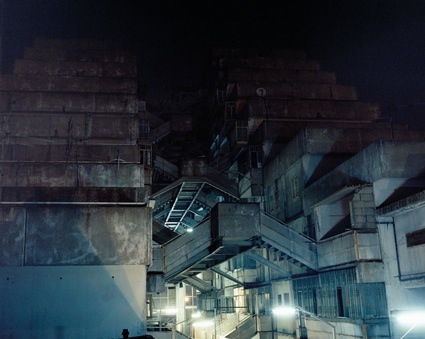
This full spectrality of digital culture - the end of the ephemeral - is a deferred promise of modernity. Recall Marx & Engels’ description of capitalist abstraction: “All that is solid melts into air.” The digital archive is the latest, perhaps one of the last stages of this process of spectralisation, and its effects are complex. One can trace this spectral abstraction in the forms of media themselves, but also in how artistic works relate to these processes. The last decade has seen great critical focus on 'haunted' practices in experimental and art music, with the sounds of decayed media being brought into the foreground of the work, or with references being drawn from half-remembered utopian histories, phantasmagorias of other futures. To trace this out within photography: moving on from the digitally simulated fake ‘vintage’ aesthetic, we might consider the attraction of the obsolete, which can be witnessed in the fascination with superseded equipment, which are minor monuments to a different regime of materiality. We might see it in the attraction of ephemera (in the historical sense), lost postcards and trivia, fragments in the Benjaminian sense, like withered corpses, testaments to disappearance, while simultaneously totems to ward it off. Jefferson Hayman's images are testament to this mood, slyly inhabiting the historical garb of the 19th century. But if we can take this dialectic further, it is possible for work to further abstract these qualities; one approach might be to introduce decay into photography. This could be abstracted in a narrative sense - the lurid colours of David Maisel's 'Library of Dust' take on an unbearable weight when one learns of their provenance. But decay here might be a controlled and abstracted figure – take Mikael Gregorsky’s photography, with its dusty phantasms. Gregorsky's portraits, although entirely contemporary in terms of setting, dress, character, technique, cannot but help to bring to mind Victorian ghost photography, as the dust introduced into the development process becomes akin to the ectoplasmic expulsions of a channelling medium. And we might find also think of ghosts of history, whether that be images of long lost objects, buildings, places, or the mute horror of scenes of historical tragedy - this spectral sublimity can be witnessed in the image of the 'Cathedral of Light', Albert Speer's horribly stunning climax to the Nuremburg rallies of 1933, the ultimate point of modern architecture as a dematerialized space of communion. But spectrality also deals with the ghosts of the future, which we can understand through the fixation on resonant utopias that we see in Rut Blees Luxemburg, whether that be in the post-war architecture of the welfare state, transfigured by long exposure to the night, or in the encounters with the skeletons of World Expositions, temporary monuments to the future, now dilapidated; left behind. They represent material promises of a different, better modernity, haunting in their very refusal to vanish.


Steffi Klenz, 'Untitled', 2010

To think of media in this spectral fashion is to attempt a synthesis of approaches to history, psychology, memory and technique that is undeniably post-modern, but offers the chance to escape the trap of irony that this might normally suggest. The figure of the ghost identifies an aspect of human existence that can be traced variously through space, the individual, the collective, and time. It is compelling way of theorising mediation and our relationships to the labyrinthine archive of human work that we are always lost within.

Sunday, 23 January 2011

Soixante Huit Cumbernauld


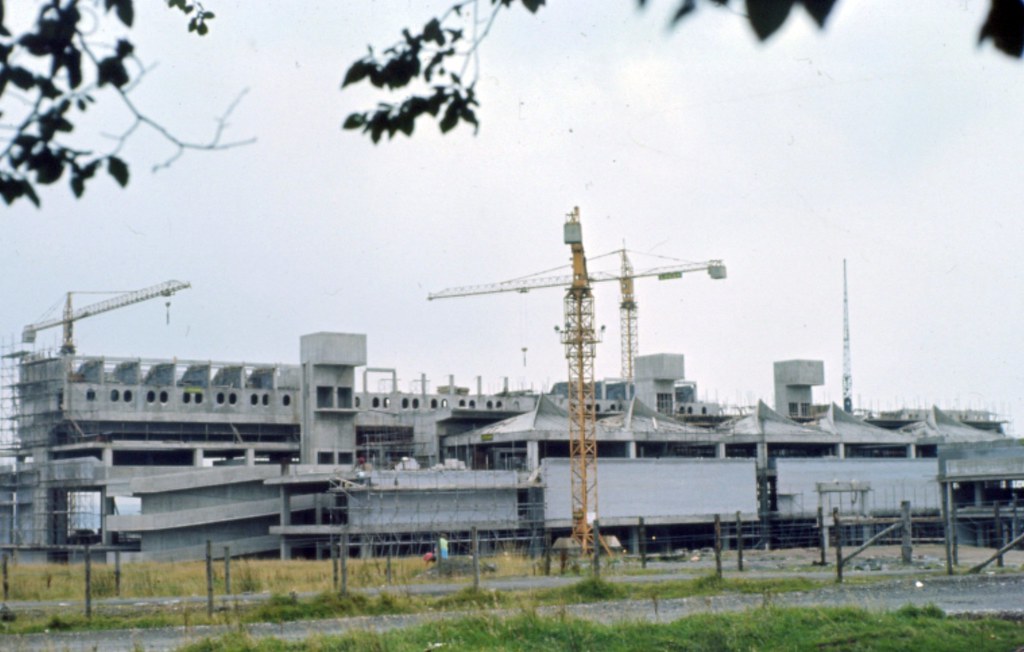
I previously mentioned 'Between Channels' putting up a series of photographs that they got hold of, but they've really upped the ante this time, with a series of photographs of the Cumbernauld Shopping Centre, award winning megastructure and Britain's most hated building.

I'm less concerned with the quality of the architecture as we all know that it's not a great building, for various reasons, but the photos are textbook 'h---------' (which god knows seems to have descended into endless bad-nostalgia for shitty witch-related tv programmes...), the grain, the bleached colours, the emptiness, the sense of futures past... They remind me of this set of photographs of then contemporary architecture, all pristine and yet faded.

Two things stick in my mind, however: one is this image of what looks like a stunning bookshop, with that now deeply unfashionable use of timber panelling:


And the other is this image from Iqbal Alam's collection of photos:

This shows the construction of the Cumbernauld Shopping Centre, and is perhaps as close to a genuine early Archigram structure you'll ever get.

Monday, 17 January 2011

Up n Coming

Here are a few things that are happening now/soon, or are just worth looking at:

-Mark Fisher and Nina Power will be talking at the ICA on Saturday the 22nd, and it's free. The press release describes the event as "A public discussion on how the dissemination of artwork and information on blogs’ and websites has altered the way that artists distribute and discuss their practice."


-Between Channels is posting a wonderful series of photographs of UK towns in 1968 that they found. They're gorgeous in their own way, and in the words of Mr/Ms Channels: "This is just everyday life as it once was, and never will be again."

-A really rather terrifying post from City of Sound regarding the Australian floods.

Trailer – The Pruitt-Igoe Myth: an Urban History from the Pruitt-Igoe Myth on Vimeo.


-There is a film that has just been made about the reality behind the architectural myth of the Pruitt Igoe flats. Hopefully there will be showings in the UK at some point in the future.


-A post on 'We Make Money Not Art' highlighting some fine art photography of 'La Vela' in Napoli, one of the most notorious housing estates in the world.

-If you're into philosophers who have spies telling them when you've sarcastically mentioned them on twitter, or even if you're just into some of the most interesting young thinkers currently active, then there is a new collection of essays, 'The Speculative Turn' which can generously be downloaded from here.


-There is a little exhibition down at the Nunnery in Bow, where artist Simon Terrill has created a massive photograph of Balfron Tower and its residents. There is a symposium on Thursday the 20th of January with Edward Colless, Nigel Warburton and Owen Hatherley.


-And finally; I will be giving a talk and taking part in a panel with Rut Blees Luxemburg at the London Art Fair. The theme of the talk and the accompanying show is 'the Ephemeral', so I'll be cracking open a can of 'spectrality' and discussing representative media, ghostliness and probably a bit of politics as well.