Saturday, 15 June 2013

An afternoon in Newcastle/Gateshead

Work took me north the other day. I'm familiar with passing through Newcastle/Gateshead on the train, the high drama of the landscape, when approaching from the south mainly rolling, suddenly dropping away beneath the train, leaving you with that stunning view of the bridges and landscape beneath. But it's been any number of years since I last got off the train there.


I've said it before, and I'll probably say it again and again, but one of the things that is really striking about London is the lack of elevated positions. Apart from a few hills way out, the inner parts of London are flood-flat, a remnant of its marshy beginnings when much of it was neither land nor river. The normal experience of London, so punctuated by underground travel, is that of being hemmed in, with no terrain but buildings, and a sky with no real boundary to it. But coming from Glasgow, you're used to being able to see the hills that bound the city to either side, of being able to frame your location on a geological level. Newcastle seems to possess another quality entirely, where the buildings and landscape are almost hewn from the very same pale stone.


Where embankments, clifftops, facades and infrastructure fail to delineate themselves, become parts of each other.


Or occupy space in a completely inappropriate way, with the eaves of buildings almost kissing the bridges that thunder over.


I mean, what kind of thuggish futurism is this? Somewhere between the 19th century spatial adventure of the Brooklyn Bridge, and the now so reviled motorway flyover, this Jazz Age behemoth is an utter thrill to encounter.


The swing bridge over the Tyne was a project of William Armstrong, just one man who more or less embodied the 19th century. An engineer, inventor, a rational man of science, a good moral Christian, a millionaire philanthropist who made much of his money as an arms manufacturer, he was the renovator of Bamburgh Castle, a sublime medieval coastal fortress turned into a strikingly complex Victorian residence, and of course the builder of Cragside, that singular, sprawling, gadget-filled mock tudor country house out near Rothbury.


Newcastle is famous for its female population and their, shall we say, frugal attitude to clothing. Coming from Glasgow I'm used to seeing lines of women queuing up outside clubs on wet, windy, just above freezing evenings, each sporting little more than a vest, mini-skirt and possibly a light jacket held over their head to keep their hair dry, but elsewhere it is definitely the Tyneside lasses whose reputation precedes them. I hate to confirm stereotypes, but something was very odd while I was there - not only did the vast majority of the people out on the street seem to be at most 21 years old, but almost all of the women were totally playing up to the cliche, all out in denim hot-pants on what was by no means a warm day, while the boys all had their faded jeans and pastel coloured polo shirts on. They all seemed in good spirits, travelling in large groups, and strangely were all drifting in the same direction.     


I later found out that they were all going to a music festival that was on that day, but it was a very odd experience, like something out of Logan's Run where everyone over thirty is dead and the youth do nothing but frolic.


Lord Foster, Foster and Partners... what is to be done with them? The man and his firm have been so influential, have innovated in so many ways that it's almost a shame to be forced to hate some of their shitty buildings, but there's really no excuse for the Sage Gateshead to look like some kind of digitised maggot.


Overall the banks of the Tyne are one of the most complete examples of post-industrial regeneration, speculative culture, historically aggressive upmarketising. I was heading to the BALTIC centre, originally the flour mill, now of course converted into a large gallery. It doesn't need explanation, this regeneration lark, because by now it feels like we're in a whole new world entirely. It's been more than five years since the economic collapse began, and, you know, depending upon who you talk to this collapse may well be the 'big one', a perfect storm of money and work and food and technology and weather and everything, that'll certainly not eliminate the advances of modernity, but will choke off access to them for all but the tiniest little sliver of the super-elite, with the rest of us fighting for scraps outside the gates. But even the optimists concede that it's the worst economic crisis in a whole century, with still no real sign of anything like normality approaching any time soon. With this in mind, the last decade's optimistic post-industrial reclamations for culture already feel so very far away, a paradigm-shift ago.


A Matter of Life and Death
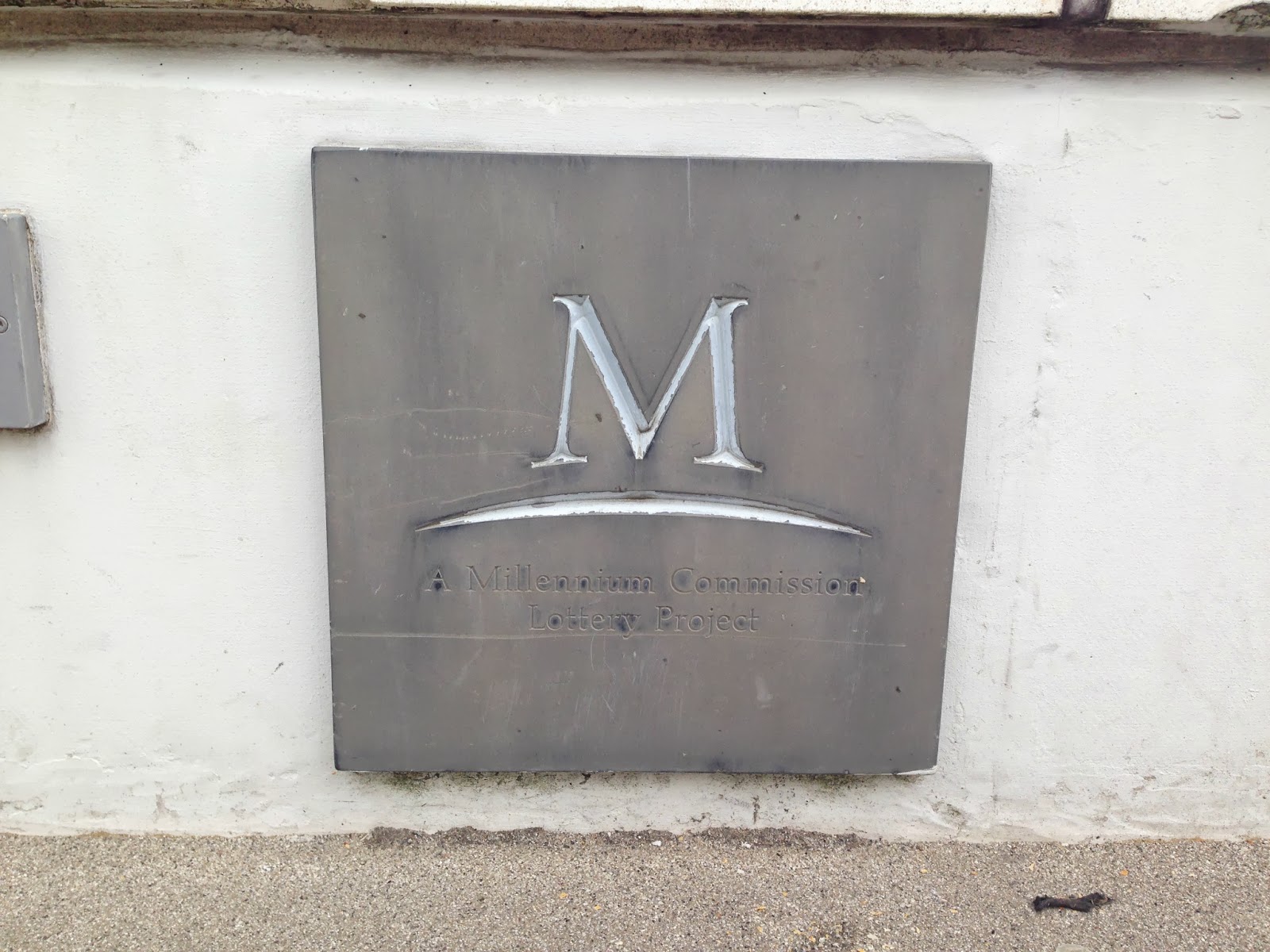

The millenium was a whole 13 years ago now, for example.


And can you see that blue and white and red thing popping up there on the horizon? That's the tallest building in the Byker development. Designed by Ralf Erskine, it might well be one of the most significant housing developments of the late 20th century, at least in Britain. Beginning construction at the turn of the 1970s, it spent over 20 years on site, with Erskine famously opening a community office for residents to take part in consultations regarding what would get built there. At the time the development was commencing it was totally against the grain for being colourful, brash, decorative and perhaps 'unserious', but its design was still effectively late-modern or brutalist in terms of massing and formal conceptions (deck access and so on). By the time it was complete it was abnormal for not being ironically vernacular, and indeed for being newly built social housing at all.

But twenty years later, after the millenium, the Erskine design language - through the bastardisation of his work at the Millenium Village down in Greenwich - would feed into one of the dominant modes of building housing in the UK. The pseudomodernism, IKEA modernism, CABEism, call it what you want, the apologetic materials and stunted massing, the attempts to pass off Britain's zombified culture of rentierism as European civic living, it was so often dressed up in a cobbled together garb which unfortunately owes much to the experiments begun here.


And for a shocking example of this you need look no further than the devilish blocks built behind the Baltic. Tactless, shoddy, aggressive in their attempt at 'blending in', there's nothing to recommend them.   In their total crassness they act as little symbols of the problems of the British attitude to housing, and to the rudderless funk that British architecture found itself in in the last decade.

But that said, the BALTIC itself was nice enough, with slightly vertiginous external lifts or wide open mirrored stairwells, and with a number of large, perfectly functional gallery spaces. At the very top there is a restaurant, which if I'm going to be thoroughly snobbish, looked to be one of those places which are so unsure, so slightly ashamed of their location that they pander to a strange notion of cosmopolitan classiness that has nothing to do with the place they belong to - overdressed staff, clingy service, a strained-stylishness to the design. Growing up, Glasgow was full of these places, London has none. At the bottom, the cor-ten steel was looking a little more grubby than it usually ought to, and the gift shop wasn't particularly large. It reminded me of Meades' talking about the glut of galleries in his On the Brandwagon, and about how there simply isn't enough good art to go round for every single city to have a massive Tate-style branded art space. But though there is a truth there, it is manifestly unfair - why the hell shouldn't every city have a contemporary art space? Why should you have to get on the train to London for anything at all, let alone to see some post-post-post-Duchampian conceptualist from Croatia? Furthermore, it's manifestly unjust for places like the BALTIC to face a 100% cut in funding, cruelly forced by directive from the callous shire-dwelling scum who 'lead' us now.

Downstairs, in the ground floor cafe, my neighbours were conversing on nihilism and sourdough bread. Perhaps it's the same everywhere after all.


And from one form of obnoxious contextualism...


...to another.


Pictured here are a number of the drifting young people I mentioned above. At this point I was almost pushing against a tide of them as I walked up the hill further into Gateshead.


The arse-end of a Foster blob, skips and all.


The crowds of young men and women were in good spirits definitely, but there was definite evidence of their commitment to the derangement of the senses.


Of course not.


A little up the hill, an example of the 19th century civic architecture that is so notable across the north of England and in Scotland. A limestone or sandstone Edwardian Baroque, robust, confident, unpretentious. This building is now marooned on a traffic island.


Here it looked as though a building had slid into the ground, leaving some kind of metallic trail in the air behind it, almost as if there's a lever that can raise or lower the facade at will.


In my hand is a postcard I bought in the gift shop at the BALTIC. It shows 'Trinity Square', better known as the 'Get Carter Car Park'. I am standing in a position that a few years ago would have shown the image depicted on the card. Behind it is what sits on the site now, a Tesco super-development featuring housing, mega-market, underground car-parking and retail units. I can still recall seeing the car park from the train in past visits, appearing just as a series of horizontal black shadows against the sky, perched at the top of a hill, appearing for all the world like one of the Northumbrian castles that dot the shores nearby - Bamburgh, Lindesfarne, or the dramatic, potent ruins of Dunstanburgh.


The Trinity Square development was designed from 1962-7 by the Owen Luder Partnership, in particular by Rodney Gordon, that debonaire playboy brutalist, one of the real architecture personalities of the era (along with but for different reasons John Poulson). Gordon died recently, but not before he had to suffer the indignity of many of his best works being humiliated and then demolished (including the 'Dunston Rocket', a gloriously barmy tower a few km to the west) . Working at the rough and ready commercial end of the industry, Gordon still managed to design and construct some of the most dramatic and masterful buildings of the post-war era, a true British brutalism comparable, as Meades says, to the insolent braggadocio of Vanbrugh. But by the end of the century the work was popularly loathed and despised, piss-stinking, rain-stained, a hellish artefact from the foolish attempt at social modernity that Britain tried and failed to achieve. Let's not go over this again, the amount of breath wasted and keyboards worn down rehashing the arguments for and against brutalism hasn't really got us anywhere.


And with the Tricorn centre gone, the Dunston Rocket gone, the Milford Towers in Catford awaiting demolition (by Tesco, again), it almost seems like there's a vendetta against Owen Luder buildings. But that's not the case - indeed, the very commercialism of their programme has worked against them. As far as Tesco are concerned, there's no aesthetic or cultural argument being made for demolition in these cases. What has now been built on the site of Trinity Square is at least five or six times bigger in terms of floor area, with units specifically configured for contemporary retail usage. It's a utilitarian, commercial decision that leads to demolition in these cases. But what happens when these plans are made is that architectural experts and aficionados point out the significance of the buildings, their importance to the history of our cities and their high quality in terms of design, and make the case for preservation. To counter these objections, all the councils (who are almost invariably in favour of redevelopment, for obvious reasons) and developers have to do is mobilise the latent public dislike of concrete architecture and turn what is nothing more than a numbers game into a crusade to rid our cities of these symbols of poverty and misery. It's worked before, and it will probably keep working, although the ongoing battle for Preston Bus Station shows that in this world of austerity, the fight for preservation has a stronger hand than it used to.


To this day, the site of the Tricorn Centre is still just a flat car-park. Not so for Trinity Square, where redevelopment appears to be around 80% complete. But just look at how bad this design is, with its silly tinfoil hats, its jolly multicoloured tiles, its half-hearted stone cladding, its Arial Bold signage.


its further examples of crass, tired, pointless contextualism (red brick! limestone! it matches, look see!)


Although across the road, THIS is still there, for some reason. Oh, what happened to the cheap metal-clad, round detailed architecture that tried so hard to cling onto brutalist principle when the tide was turning towards post-modernism and pastiche? It's not an easy kind of building to like, but is interesting for its links to both styles, as well as its affinity with big-sheds, the true architecture of post-containerisation capitalism.


Too many materials? Stupid roofs? Silly colourful cladding? Privatised public space? Quasi-policemen everywhere? Nobody is going to fight for the preservation of these buildings in 40 years time when the guarantees on the materials have all run out and the wafer-thin stone panels have fallen from their sockets.


Some more festival-style shops still exist, perhaps because of their simpler design being more amenable to conversion and internal refurbishment.


And some handsome terraces, perhaps a little to grand for worker's housing, now seemingly home to solicitors and other professional offices.


Think of what's now missing. And when you consider that take-over attempt in Peckham, where a bunch of posh, white, fabulously well-connected young people want to turn a car-park into a permanent arts space, there could have been something much better done with a partial redevelopment of Trinity Square.


It was time to go. Tower blocks across the country nowadays are so often covered in noddy hats and external insulating render, in various different friendly colours, that it can be quite odd to see examples that appear to have retained their original sombre colours. I suspect this one might have been tinted, but it's certainly not had the facade re-worked or over-clad. It stood rather lonely on the sides of the grand slope down to the river, with a verdant pathway approach from the centre. Probably not so nice to walk down at night, especially not with youths hanging around in the park, but I imagine the views from the top are something else.


Elevated concrete walkways. It's a shame how something so placid, such a sensible improvement in management of transit, such a simple concept as the raised walkway, how it became such a seemingly terrifying thing. With those staircases it becomes almost akin to moving around in an abstract sculpture, all dramatic mass and poised line. But of course there is a sense of being trapped, of being vulnerable to whoever comes along from the other end, but that is by no means a given, and we don't go ripping up Edinburgh despite the genuinely dangerous nature of the lanes that slice across the old town.


Here was another estate, largely boarded up. Low rise, stepping down the hill, nestled in the curve of the railway and the busy main road, it -again- occupied that grey area between post-war modernism and  postmodern detail. Massed almost like a boxy De Stijl composition, all cubes seemingly interpenetrating with themselves, it nevertheless had classical porticos tagged onto the outsides.


It's very possible that the doorways are a later addition inspired by the work up at Byker. There was almost nobody around, although there were still houses in occupation.


Who knows if these things are effective, but there's something chilling about their perfunctory design quality and the sheer painful depth of mental state into which they are meant to intervene. Someone connected to me took their life by jumping from a bridge, their empty car was left half way along, and there were witnesses who recounted what happened, but their body wasn't found for quite a long time afterwards. 


And across the bridge. At one point you would have been able to see the Dunston Rocket from here, poking up to the left of the image. Gone.


Di Dodi Die


And from here you would once have seen the Trinity Square Car Park. Gone. Along with no certain amount of civic confidence.


I swear this walkway was an unpleasant experience. About 1200mm wide, with cars passing at 60 miles per hour to one side and a 40m drop to the other, and the bridge being perhaps a mile long, it's the stuff of pursual nightmares.

MAJOR MIXED USE DEVELOPMENT (or not, perhaps)


And with more time I might have gone up to see that tall one on the Newcastle side, which looks quite exciting to me.


And back to Blairism. This concoction is one of those science museums that were built up and down the country in the last decade or so. copper clad, irregular, a mish-mash of shapes, it's got pseudomodernist brandwagon written all over it.


And this kind of bollocks again. This is exactly the kind of rubbish that Erskine was the unfortunate trailblazer for. Many materials, many colours, huge massing pretending to be a collection of smaller buildings, poky windows, a paucity of ambition.

Pictured to the right appears to be Newcastle's gay quarter, all one street of it.


Huh?


And I should have known they'd have a Charles Jencks DNA sculpture in there. Always interesting, always wrong.


And getting ready to go home, there was a great addition to the genre of 'buildings within buildings', this little British High-Tech pod of shops. Shades of Richard Rogers and his factory designs, with the ringed columns and tension cables, and charming with its filleted corners and sleek shininess. I'm told it's going to be removed, as they're 'upgrading' i.e adding more shops to the station.


And a train went through, laden with coal, probably from the Port of Tyne. Of course, time was that Newcastle was a coal city, but that's pretty much all gone now too, and one can't help but reflect on the way that the decline in civic modernism, and the sense of pride that went with it, was tied in with the decline in industry, the further and perhaps final centring of the British economy in London. Let's go ahead, be vulgar and stress the connections between industry, pride, social democracy, abstraction and modernism, and conversely speculation, rentierism, 'gentlemanly capitalism' and classicism, deference and so on. It makes sense. 

Monday, 18 March 2013

Summers on the Estate

One striking thing about the East End of London is how much it as physically changed form in the last 20 years. At around the time that the warehouses and lofts of Shoreditch were being rediscovered by the art crowd, Hackney Council was engaged in a huge programme of destruction, as various housing estates were demolished. Nowadays there are large areas you can walk through where the Victorian terraces give way to a strange, oddly suburban landscape of semis, apologetically detailed, measly in scale and generally nondescript. More often than not, if you scratch the surface you find that you are walking through an area which was at one point a large and notorious housing estate.

Despite all the much-discussed gentrification, there's probably still a large majority of people for whom the names Trowbridge, Holly Street or Nightingale conjure up memories of concrete towers, crime, drug addiction and squatting, and all the other cliches of the 1990s. One such estate, perhaps more notorious than most, for reasons we'll get to below, was the New Kingshold Estate.

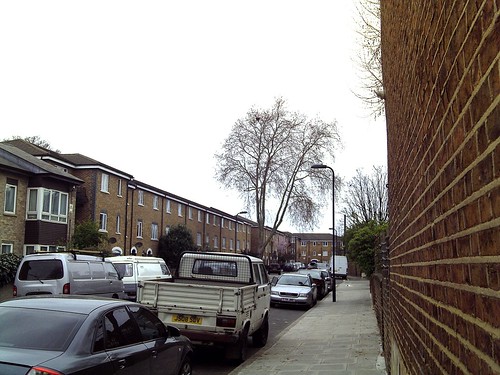
Take a look at the image above. It shows the limits of the New Kingshold Estate. If you're a Londoner you'll note the northern edge of Victoria Park at the bottom - today an area of high house prices, twee delis, baby yoga and all that nonsense. If you look at the area within the red line you'll see it is mostly pitched roofs and gardens. Indeed, the housing looks like this:

Handley Road, Kingshold Estate, London E9, March 2012

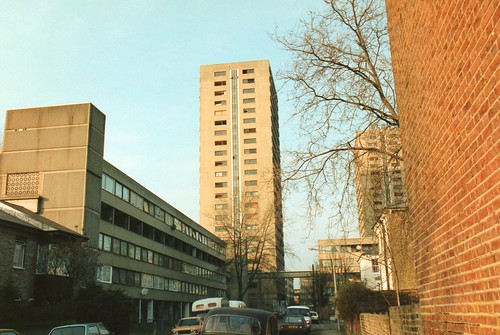
Which I'm sure everyone would agree is pretty boring as far as housing goes. It's almost trying not to be seen. But up until 1995 that very same street looked like this:

Handley Road, Kingshold Estate, South Hackney, 1993 - 4

Or - good grief! - like this:

kingshold estate e9 1987-1999

But of course if you didn't know, you wouldn't know. The New Kingshold was just one of a great many housing estates now demolished, caught up in the maelstrom of political and cultural attitudes to housing from the 1960s to the present day. But one thing that made it particularly famous was its starring role in a 1990 television documentary called "A Summer on the Estate".


This, unfortunately, just needs to be seen. The sheer misery which the people featured in this programme are obviously going through is difficult to watch. From the head of the tenants association nearly killing himself with stress as he fights for the rights of his fellow residents, to the soft-touch alcoholic unable to intervene when his 'friend' attacks him and his family, to the images of the decayed scalp (yes, really) of an elderly man whose rotting corpse lay undiscovered for weeks, it's really harrowing to see people live like this. And the architecture gets it too - the asbestos-ridden partitions, the maggots, the cockroaches, the boarded up flats, it's quite obviously a shit-hole.

But there's more going on; the programme sympathetically depicts the community activities of a group of squatters, acting as an underground housing association for those in need, walking local dogs, keeping children occupied and attempting at least to help clear up the previously mentioned dead man's house. The battles against the council to have something done show both how hamstrung the councils were when being mutilated by Thatcher's tories, while also depicting their ineptitude and general disregard for the people on their hands.


The second programme isn't much easier, with the story of the woman for whom the inability to have something done about her cockroach infested flat contributed to a nervous breakdown and the disintegration of her marriage a particular horror. But there's more going on again - nobody would begrudge these people the joy they exude when the towers are finally brought to the ground, but these very same people are well aware of the problems of what will come after, with the council barred from constructing new council houses and the questions of belonging and ownership that come with them. Indeed, many people express a genuine love for the estate, with the memories they had deposited there since they were built in the 1960s, their hatred being focussed on the problems of maintenance and neglect and general disregard shown to them by those in power. 

In fact, the whole thing is a remarkably balanced view of all of the problems that showed up in these neglected housing projects; for every well-built Barbican there was a Freemason's Estate, and the fallout of that period of ultra-high housing targets, unproven pre-fab technologies and a sometimes fatally corrupt construction industry is plain to see. The war against local government is hammering these people, pawns in a game to turn everyone into a little tory landowner, and their desperation just to have any say at all in what happens to them and where they live is tragic. 

And yet, and yet... look at us now, in a housing crisis that's battering all but wealthiest echelons of society, a housing crisis leading leading to the people forced to live in 'super-sheds' in the back gardens of these very new-build terraces, where being able to afford to rent even just a room of one's own is becoming more of luxury for young people even into their thirties, a housing crisis with a shortfall in construction of around 100,000 units a year, with new 'luxury' flats often smaller than even the shoddiest of the system built blocks, one can't help but think that if something, anything could have been done to bring estates like these up to proper standards, then that would have been so much better than what we're faced with now.

Friday, 21 December 2012

Some notes on Bach.

If it’s alright with you I’d like to share some notes on Bach.

There are a few little interesting historical anomalies that mean that there’s something really rather interesting about playing J.S. Bach on the guitar. The first is the fact that the guitar is a classical instrument which only really became ‘serious’ in the 20th century, meaning that its repertoire is a) distinctly limited, and b) mostly rather lightweight, decorative stuff, even at its peak only rising to a kind of banal romantic whimsy. This has led to the guitar being a predominantly solo instrument: not being part of the romantic orchestra and not having many significant ensemble parts written for it, guitarists generally perform alone, like pianists. Furthermore, if the performer finds the general repertoire uninteresting, then they are forced to play transcriptions of works for other instruments; this has become an integral part of playing the instrument, which my amateur attempts at Chopin’s preludes attest to.

As far as Bach is concerned, there are two things we might note; one of which is that as a Baroque composer, the instrumentation of his works are somewhat malleable- there were far more different instruments in common usage back then, and a great many works are orchestrated for whichever musicians happened to be at court at that time. Furthermore, there are a number of instruments which are somewhat unclear - the mystery five stringed cello from BWV1012 for example, or the debate as to whether or not Bach even wrote music for the lute, or rather the gut-stringed harpsichord called a lautenwerk that he certainly owned a couple of. It seems that there is a certain ‘interchangeability’ to Bach’s music, where, especially with its famous logical consistency, not to mention his own habit of transcribing, it lends itself to being moved from instrument to instrument.

So with this in mind, I’ve recently been playing Bach almost exclusively (bearing in mind any playing at all has to fit in the cracks between Job 1, Job 2, freelance work, not dying, and all the other things I regularly struggle with), and have alighted upon a ‘core’ selection of works to play. Yet another auspicious aspect of Bach’s music is his writing for solo instruments, for so long dismissed as mere studies, but then so unbelievably influential over new music in the 20th century. It is these that form the basis of what I’ve been playing.

Lute Suites BWV995-1000

As I mentioned above, the suites for lute were almost certainly not written for the actual lute, and are actually keyboard music with a lighter polyphonic texture than usual, and I generally play the transcriptions for guitar by Jerry Willard.
BWV 995 is Bach’s own transcription of Cello Suite 5, BWV1011 with added voices, and so I consider it part of that work.


BWV996 is a Suite in E minor, with some very challenging three and four part writing, with the initial Presto and final Gigue really impressive.


BWV997, another suite, is most notable for a long, powerful minor-key fugue.


BWV998 is the serene Prelude, Fugue and Allegro, a beautifully majestic mini-suite which is an absolute joy to play, especially the fugue and its slow build-up of its three parts.


BWV999&1000 are a prelude (akin to a minor key version of the prelude of BWV1007) and a fugue that is based upon the violin fugue from BWV1001, one which was a favourite piece of Julian Bream.
As well as all these, BWV1006a is Bach’s own elaboration of 1006 for the lute, which is best played in place of 1006.

Violin Sonatas and Partitas BWV1001-1006

Where the lute suites are often richly polyphonic, the violin works are much more varied - a great number of them are composed of single lines, where all harmony is implied, while on the other hand, there are a number of pieces which utilise all four strings on the violin, giving serious polyphony. I generally play Tadashi Sasaki’s transcriptions, which maintain all the original keys.


BWV1001 in G minor has an incredible prelude, all ornament and lugubrious harmony, a real joy to play, including just the most exquisite deceptive cadence near the end. It’s followed by a fugue, a siciliana and a solid presto.


BWV1002 is rather long, and contrasts a series of dance movements with Doubles in single lines.


BWV1003 was transcribed by Bach himself for the harpsichord, and so there is a version of much thicker texture and ornaments that the performer can pick and choose from. This sonata is completely dominated by the Andante, a piece of unbelievable spiritual calmness and power, one which Bach actually made worse by elaborating it for the keyboard. I was lucky to hear this played by Frank Peter Zimmerman as an encore this summer at the proms, Mein Gott!


BWV1004 is the D minor partita, which is most famous for the Chaconne, which completely dwarfs all of the movements preceding it, for good reason: without hyperbole, it’s one of the most incredible achievements in all music, grandiose, tortured, passionate, sweeping, emphatic.


BWV1005 is another sonata, with a gigantic fugue as its second movement. What is most exciting about this one though, I would say, is the faltering, heartbeat-like prelude, building from near silence into glorious, churning, four-part grandeur.


The prelude of BWV1006 is a guitar favourite, and for good reason. Its effervescent, joyous, rolling rhythm creates a wonderful web of sound that is ideally suited to the guitar, and as I’ve mentioned, there is a ready-made Bach transcription for multi-stringed instrument. In my opinion, however, the rest of the suite can’t really match up to it, despite its charm.

Suites for unaccompanied cello BWV1007-1012

It’s a little bit harder to do these ones justice, such hallowed works, inextricably tied to Casals and his grainy, over-romantic resurrection of what were once simply practicing etudes. The least polyphonic of Bach’s solo instrumental works (not counting the flute partita), they are also the most awkward to transcribe. Unlike the violin works, which can literally be played off the stave in the original without edits, the cello suites have to be completely transposed in order to fit the guitar. Furthermore, decisions have to be made as to how to treat the texture of the pieces - the guitar, charming though it is, simply cannot compete with the cello in the power of a single line, and so the suites can sound naked in a lot of places if they are not dressed up. However, that opens cans of worms about how much tinkering one is allowed to do to the beauty of the original. I’ve encountered a variety of approaches, and I think it depends upon what each of the suites demands in its own logic.


Everyone knows BWV1007! It’s got to be one of Bach’s most famous pieces, recognisable from a million recordings, the background of a innumerable films and so on. I play a transcription by John Duarte, which has become a classic in its own right. He fills the texture out considerably, making for quite rich and challenging pieces, which I think suits the jovial nature of this suite.


BWV1008 is the opposite - sparse, melancholic and vulnerable, to me it sounds better with its nudity emphasised. I haven’t found a satisfactory transcription of this one, so I’m working on my own at the moment, which I’ll probably continue editing as time goes on.


BWV1009 also has a satisfying edition transcribed by Duarte, with slightly less added texture but still a rich and open sonority is achieved.


BWV1010 is proving slightly tricky. The transcription I’m working with happens to be in the same key as BWV1009, and despite me not playing one after the other, I feel that they ought not to be structured in this way. I’ll have to have a further think about this one.


As I mentioned previously, Bach himself filled out BWV1011 into BWV995, and this is excellent help in deciding how to go about playing the others. This is the home of the sarabande, that timeless single melody which sounds like it could easily have been Webern. It’s hard to achieve the same gravitas on a guitar, but it’s worth trying.


And of course, BWV1012, the mighty end to the suites. This is particularly challenging, featuring quite a lot of passages of incredible speed and difficulty, written as it was for the mystery five-string cello (which some believe might have been more like a viola!). Again, I have no decent transcription to work with, so I’m editing it myself. The highlight just has to be the overwhelming, titanic prelude.

So overall that’s eighty-three movements and almost five and a half hours of music to play through (I haven't included the flute partita because I don't know if I can be bothered at the moment). It’s very comforting music; in turbulent times, both worldly and personally, there’s something steady and firm about Bach’s formality, his a-historicism and pre-modern sensibility, that seems like the right thing for me now. I’m still working on transcriptions but I have much less time for that now. We’ll see what happens, but I’m quite keen, if I get bored of this regime, to start really working on some of the more modern C20th guitar works, of which there’s reassuringly quite a lot. On the other hand I have some transcriptions of Bach's keyboard music (including some quite infamous Well Tempered Clavier transcriptions) which if I'm feeling very confident about I may try to work on in future.

Monday, 17 December 2012

Owen, Dezeen, photography, criticism and its decline, etc etc


[EDIT - For some reason I lost the second paragraph of this piece when I originally posted it - I've now put it back in]

In the last week there was a very minor spat, which although silly, does point to some interesting difficulties in the way that architecture is mediated these days. It concerns two very different approaches to how we discuss buildings. It started with Owen Hatherley writing a blog for the Photographer’s Gallery, about modern architecture and photography. Overall this focussed upon various topics close to Owen’s academic work; critiques of Neue Sachlichkeit, constructivist photography and the influence of black and white photography on the design of early modernist buildings. It’s all very interesting, and you can read it here.

But it’s Owen’s opening gambit that’s of interest here. In it, he laments that the current archi-porn websites Dezeen and Archdaily “provide little but glossy images of buildings that you will never visit, lovingly formed into photoshopped, freeze-dried glimmers of non-orthogonal perfection, in locations where the sun, of course, is always shining” - a situation he describes as “disastrous, a handmaiden to an architectural culture that no longer has an interest in anything but its own image.” While I generally agree, I think that there still needs to be a proper discussion of super-photographers like Iwan Baan (who recently jumped into mainstream media by taking that image of Lower Manhattan blacked out after the storm), but that will have to come some other time.

Within a day however, Dezeen posted up a link to this very article, summarising its points, under the headline of ‘Architecture “no longer interested in anything but its own image”’. Rather cleverly they’d found a picture of Owen being all vain and Bowie-ish, thus somewhat hoisting him by his own petard. Underneath, Dezeen editor Marcus Fairs did actually respond, saying “Rather than being "utterly distastrous [sic]" for architecture, sites like Dezeen are a powerful new platform for presenting and discussing architecture in new ways, in front of far bigger and more diverse audiences than the old magazines (and their hermetic writers and critics) ever managed to reach. It's a huge opportunity.”

Of course, Dezeen’s posting up of Owen’s criticisms is amoral recuperation - as a web-business, anything that gets them ‘hits’ is good, so it matters not a jot whether Owen’s right, because it only makes them stronger - and one can imagine them laughing away in the office at the irony of their choice of picture. But it’s also very symptomatic of where ‘criticism’ is at the moment.  Owen has never made any secret of his distaste for these sites, although he luckily doesn’t need to keep a close eye on them - my RSS feed is constantly plugged into them in case there’s a press release that I haven’t received. In fact, frequently I’ll receive an email from a PR, and within half an hour or so it’s up on both Dezeen and Archdaily, wording unchanged; which certainly undercuts the journalist’s traditional information privilege. But at the very same time it also wipes out the role of the expert journalist in giving context and narrative to these unconnected images. So on the one hand you have the democratising effect of internet culture, but as we have seen in other fields, this causes a sagging in quality, and I certainly find most of the stuff that gets posted up there depressingly banal.

But both Owen and Dezeen are successful - now that Owen basically doesn’t blog any more, he’s occupying a very traditional niche of the writer/journalist, creating long arguments spread over hundreds of thousands of words. On the other hand the archi-blogs have been traditionally devoid of original thinking, but neither Dezeen nor Archdaily are as blank as they were before; for example, Archdaily now has columnists and short original articles, but they are often of cringe-inducingly low quality. Dezeen generally doesn’t speak in its own voice, but the massive increase in filmed interviews that they post up means that there actually is a rather high level of debate being conducted on the site, channelled through Dezeen rather than directly created by them. I certainly applaud this, it's certainly great to have access to people discussing their work, but I have to say that it’s also dangerously flawed. Fairs has made an incredible success of Dezeen, which now has all manner of pie-fingers, selling watches, organising events, pop-up shops, sponsoring various events and even appearing in global branding campaigns for Apple. But at the same time it buys into a rather sickly language of web-entrepreneurship, all ‘creatives’ and ‘content’ and assorted bollocks. It sails close to some very negative practices too; recently it got involved with a property developer in the East End of London, inviting local ‘creatives’ to submit work which would eventually adorn the lobbies and spaces of a new block of yuppiedromes in the extremely poor neighbourhood of Stepney Green. I personally find this horrid; you can’t claim to be celebrating ‘creatives’ while at the very same time contributing to the forces that make their lives difficult, you can’t promote the East End design scene while simultaneously assisting in its being wiped out.

So while Owen is very lucky to be in a position of disseminator of expert knowledge, creating original ‘content’ of intellectual and critical quality, it’s an incredibly hard life, getting harder by the year, as the traditional media model sinks ever deeper. Dezeen have found a platform that works, that financially sustains itself, but it doesn’t necessarily perform a useful role in terms of understanding, historical context or, of course, critique. Is the only way forward from here an ongoing obliteration of culture’s independence from PR?