Last night I flew over Iraq. I am unaware of when the airspace became accessible again, but I recall flying over the area in 2006, and the plane taking a pronounced detour all the way down the Persian Gulf, indeed, all the way over Iran instead. But now, the planes fly directly over Iraq. And looking out of the window, as we passed over Baghdad, a sense of blankness; what trauma, what chaos? Nothing of the recent history could be seen from 39,000ft, but of course, what would one expect to see? Perhaps one could read the growth of the city under autocratic rule from certain qualities of the street plan, but from up there there was absolutely no way of sensing History in any way. But what is odd about this is that seeing the dewy spider-web of a city at night is entirely anthropic; all you are seeing is population geography, urban density, the agglomeration of people. As I was carried over, I saw the daily context of millions of people, but nothing whatsoever of the struggles and agony of recent years.
Then, not long later, a strange sight. As the plane crept southwards, from under the edge of the wing, which obscured most of my view, an odd haze began to spread outwards, granular, dusty, like perhaps the halo of a star when photographed from space. Moving along, it grew brighter and brighter, to the point where the streetlights around it began to vanish, swamped by the glare. Eventually, the source of the light revealed itself from beneath the wings; an oil fire. Burning out into the night, this rusty blaze was easily the brightest thing I've ever seen from an aeroplane, so far away as to be nothing but a silent point of light, but easy to sense the slow pulsations of the oil as it blasted out. Then, minutes later, another fire crept into view, and another, and another. Eventually various strings of these lights could be seen stretching off into the night, interspersed with roads and towns whose nights must be constantly ruddy with the smoke and the light which floods into it.
And of course, this point is when one can see history. Not only in the sense of the sheer tangible sight of the economic and security rationale behind the wars of the last decade, but also in that nauseating apocalyptic sense; from the vantage point of those vast new planes that carry eight hundred people, the ludicrousness of scale, aisles with vanishing points, gates like ferry terminals, anthroposcenic economies of scale, I looked down at the vast petrochemical blazes, burning beacons of what drives us, seemingly uncontrollably, into a new future.

Showing posts with label apocalypse. Show all posts
Showing posts with label apocalypse. Show all posts
Tuesday, 29 October 2013

Thursday, 29 August 2013
Public Announcement
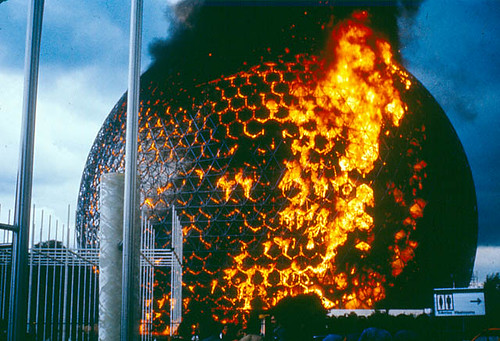
Last Futures will cut through the standard architectural histories of the period, which portray much of the experimental architecture of the time to be either hopelessly naive or impotently critical, and will demonstrate that many of the ideas and proposals of the time were more-or-less rational extensions of where things were heading at that point. I'll focus not just on paper projects, speculations and manifestos but on the more bizarrely quotidian examples of these ideas, to further stress the concreteness of these lost directions. In so doing, I hope to further develop ideas from The Architecture of Failure (which you can still buy) which searched for a synthesis between romantic and modernist concepts of architecture, and how important this task might actually be for us. Expect cybernetics, drop outs, hippies, mass-housing, biospheres, space frames, situationists, countercultures, technocrats, environmentalists, dialectics, disasters and defeats...
Thing is though; it's now been half a decade since I finished my post-grad, and well over three years since I submitted the manuscript for my first book. In the intervening time a lot has happened, but it also feels as though time has stood completely still, at least compared to how fast it moved as I went through education. I basically fell into a day job as I was finishing off the manuscript, and it has taken this long for me just to be in the position to take the opportunity to write another one. In the meantime I've written hundreds of thousands of words, for Icon and for all manner of other publications, I've interviewed many of the biggest names in architecture, I've visited new buildings all over the place, I've lectured across Europe, I've appeared in national media, I've built (with friends) various installations and small projects, and all the while I was working four days a week in an office. Add to that the slow background work of learning a completely different method of playing music, some really rather miserable experiences of various kinds along the way, and finally a period of being gravely ill and needless to say, I'm pretty exhausted.
Obviously one should never play the what-if game, but it's difficult to know how working at a pretty intense job while simultaneously trying to fit some kind of career as a writer around that would stand up, compared to some of the other options that were available to a post-grad architect floundering around in the maelstrom immediately after the crash five years ago. Perhaps, like some, he ought to have fled the country to doss about in Berlin, in which case god only knows what he'd be doing now, or maybe he should have dived straight into a PhD, which would most likely have had the word 'haunting' in the title, and would now be complete, giving him the rapidly evaporating academic world to thrash around in. Either way it certainly feels that in the last few years developing intellectually or critically has been almost impossible with the demands consistently made on my time. But never mind; these are worthless counterfactuals, of course I'm not doing too badly after all, and as everybody knows, "This life is a hospital where every patient is possessed with the desire to change beds."
So for now I'll be trying to knuckle down and get stuck into this new book, and hopefully there will be opportunities to do some interesting projects in the meantime. If you're around say hello, and let's see if something good can happen even in these worsening times.
Friday, 30 November 2012
The International Anthem
I have created a new international anthem, to be played at all public events, everywhere, from now on.
Tuesday, 27 November 2012
The Future (in 1974)
- All of the below comes from 'Man and Environment', a fascinating Pelican book, of which this edition was published in 1974. Yes, 1974! It contributes to the impression that the 1980s all the way up until 2008 were all just a procrastinator's diversion from what needed to be done in the world. Now, it looks more and more like we've missed the deadline completely, and will have just hope we don't get thrown out altogether.

PREDICTION
... the one fact about the Future of which we can be certain is that it will be utterly fantastic.
Arthur C. Clarke
Logically, the first prediction is that in the twenty-first century Europe will become a single unit for strategic planning and administration. All over the world regional 'blocs' are evolving and no faster than in Europe, not only in the economic field but also in the whole range of social activities. In a Europe planned as a physical entity, the Scandinavian coastline, much of Scotland, the Black Forest, and the Alps and many similar areas would receive priority for conservation and enhancement.
Perhaps most of England and Belgium would be accepted as primarily industrial; possibly southern Sweden would be the location of half a dozen new cities, each of a million population taken from the overcrowded areas of Europe. The planning of six new cities would call for new patterns of thinking, for no country in the Western world has so far attempted anything on this scale. Development for six million means deliberately setting out to create a new environment for more people than at present live in the whole of Scotland.
With the development of techniques like atomic blasting, vastly more nuclear power, and underground sources of oil and gas, it should be possible to create landscapes on a European scale. Resources could be developed in a vast and excitingly imaginative way - agricultural zones could be related to the value over centuries of the best soils and climatic conditions, fish farmed in barrages created for water supply, and hydro-electric schemes combined with new motorways.
More knowledge of the environment should lead to measures for elimination of elements like bronchitis, which are associated with particular environmental conditions. Great scope exists for the detection and control of illnesses related to the mineral and other content of soils. Biogeochemistry has already found some areas which are conducive to cancer or heart problems. Preliminary indications relate these to a wide range of environmental factos, including soil. Perhaps planning will exclude certain activities or uses from such areas or require the dangerous conditions to be remedied before development takes place.
Computerized inventory and processing of all resource information will have become an accepted feature of man's relationship to his environment. Research will increase in importance; its role in decision-making may be extended to promote the examination of basic assumptions and personal prejudices. Decisions should thus be based more on facts and known preferences and less on vague intuition. Although the imponderables will always count in respect of physical issues, many could be eliminated in the twenty-first century. Design-awareness centres will be an accepted 'institutionalized' part of the educational process as the public-health values of a high quality environment are accepted.
As more is learned about the diversity and quality of intelligence and man's potential for increasing it, so it may be expected that environmental conditions will be improved to enhance this most vital of all resources. The population pressure itself becomes the source of new qualities and quantities of human ability, provided that its growth is related to the development of man's intellect and his resource productivity, and that it is always borne in mind that he may have to occupy this planet for millions of years.
But optimism is denied by the assessments and forecasts made for the Club of Rome in its project on the predicament of mankind. This stresses the critical world situation arising from the many complex interactions between industrialization and depletion of natural resources, and between populations and food shortage, pollution, war, stress and disease. It forecasts a marked deterioration in material standards of living of western nations and contends that many of the proposed remedies may be self defeating. The Club seeks to identify and implement policies which will enable the world to make an orderly transition from a growth-based economy to an ecological equilibrium.
These aims received strong support in January 1972, when the British magazine The Ecologist, vol. 2, no. 1, launched A Blueprint for Survival. This proposed the formation of a movement for survival based on a new philosophy of life in harmony with the environment. It prescribed a comprehensive programme for the long-term stabilization of society based upon self-regulating systems and self-supporting communities.
Albert Schweitzer, too, was pessimistic. He said: 'Man has lost the capacity to foresee and forestall. He will end by destroying the earth.'
How then to conclude? In such a vast field and with so much at stake, it is perhaps most important to emphasize man's responsibility, and to stress the challenge he faces now.
Saturday, 3 December 2011
Sunday, 28 August 2011
Romanticising the Riots

Romanticising the Riots by entschwindet und vergeht
You might have noticed that there were some riots recently. I don't really have much to add to the hundreds if not thousands of analyses that have already been contributed, apart from the observation that they all have some element of truth to them.
One of the riots took place right outside my house in "London's Fashionable East End", and as well as going outside to have a look at what was burning (along with a sizable cross-section of the local population), I also, as you'd expect from a pretentious hipster, made an audio recording of the helicopters that were thundering around outside, of which I counted at least four.
Now, it's not as if I couldn't have just left it at that, and had myself an interesting little Chris Watson style audio recording, but I felt it necessary to somehow transfigure it slightly, and the result is the audio that you can listen to here. The helicopters have been combined with a recording of Strauss' 'Im Abendrot' ('At Sunset'), one of his Four Last Songs.
Why? Well, there could be a number of reasons. On the one hand it's a sly gesture towards Stockhausen's 'Helicopter Quartet', but that's by the by. It's also a kind of aleatoric duet - listen to how the doppler effect of one of the helicopters perfectly accompanies the slide from the major to the relative minor! But then it's perhaps about the artistic gesture as such, the impotence, or failure, of any artwork to genuinely transfigure the structure of the world into which it's inserted. The high-romanticism here functions as a phantasmagoric fragment of a world that is not always in the process of collapsing, a fiction that is always drowned out by the harsh sounds of the world in which it is heard. Or, to put it another way, high-camp futility is the mood I'm going for.
Wednesday, 11 May 2011
E&V fodder.
So let me just get this straight: Lars Von Trier's new film is called 'Melancholia', it's about the end of the world, and it's soundtracked by Wagner's Prelude to Tristan & Isolde? Ummm...
Subscribe to:
Posts (Atom)