Showing posts with label dialectics. Show all posts

Thursday, 29 August 2013

Public Announcement


Here if I may I'd like to make a little announcement. As of the end of work today, the 29th of August 2013, I will be a full time writer. For the next few months at least I will be working on a new project for Verso; entitled 'Last Futures', it's a study of technology and nature in post-war architectural avant-gardes. In it I will be telling the story of the last time that there was any real attempt made to work towards a plausible architectural future, in the late sixties and early seventies. It was a strange period when high-technology and first-wave environmentalism were prominently discussed, before both were swept aside by the rise of neoliberalism. Now from the current age it appears tragic how so many of our most urgent crises were already under discussion back then, only to be kept off the agenda for a generation until we're now at a point where the situation already appears to be too late to save.

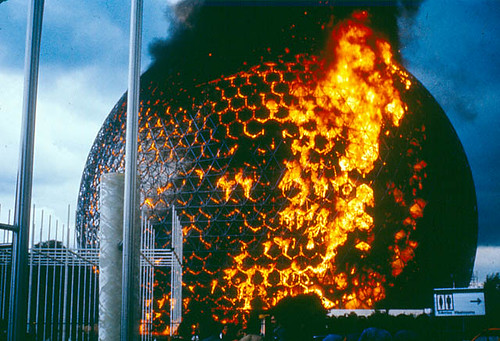
Last Futures will cut through the standard architectural histories of the period, which portray much of the experimental architecture of the time to be either hopelessly naive or impotently critical, and will demonstrate that many of the ideas and proposals of the time were more-or-less rational extensions of where things were heading at that point. I'll focus not just on paper projects, speculations and manifestos but on the more bizarrely quotidian examples of these ideas, to further stress the concreteness of these lost directions. In so doing, I hope to further develop ideas from The Architecture of Failure (which you can still buy) which searched for a synthesis between romantic and modernist concepts of architecture, and how important this task might actually be for us. Expect cybernetics, drop outs, hippies, mass-housing, biospheres, space frames, situationists, countercultures, technocrats, environmentalists, dialectics, disasters and defeats...

Thing is though; it's now been half a decade since I finished my post-grad, and well over three years since I submitted the manuscript for my first book. In the intervening time a lot has happened, but it also feels as though time has stood completely still, at least compared to how fast it moved as I went through education. I basically fell into a day job as I was finishing off the manuscript, and it has taken this long for me just to be in the position to take the opportunity to write another one. In the meantime I've written hundreds of thousands of words, for Icon and for all manner of other publications, I've interviewed many of the biggest names in architecture, I've visited new buildings all over the place, I've lectured across Europe, I've appeared in national media, I've built (with friends) various installations and small projects, and all the while I was working four days a week in an office. Add to that the slow background work of learning a completely different method of playing music, some really rather miserable experiences of various kinds along the way, and finally a period of being gravely ill and needless to say, I'm pretty exhausted.

Obviously one should never play the what-if game, but it's difficult to know how working at a pretty intense job while simultaneously trying to fit some kind of career as a writer around that would stand up, compared to some of the other options that were available to a post-grad architect floundering around in the maelstrom immediately after the crash five years ago. Perhaps, like some, he ought to have fled the country to doss about in Berlin, in which case god only knows what he'd be doing now, or maybe he should have dived straight into a PhD, which would most likely have had the word 'haunting' in the title, and would now be complete, giving him the rapidly evaporating academic world to thrash around in. Either way it certainly feels that in the last few years developing intellectually or critically has been almost impossible with the demands consistently made on my time. But never mind; these are worthless counterfactuals, of course I'm not doing too badly after all, and as everybody knows, "This life is a hospital where every patient is possessed with the desire to change beds."

So for now I'll be trying to knuckle down and get stuck into this new book, and hopefully there will be opportunities to do some interesting projects in the meantime. If you're around say hello, and let's see if something good can happen even in these worsening times.

Thursday, 3 November 2011

London Bridge, 1st November


For various reasons, the 1st of November 2011 was not the sort of day one wishes to go through. As part of this horrid spin I had occasion to walk across London Bridge along with the lord knows how many other thousands pass across as it as well, perhaps a six figure number. Before reaching the bridge however, I had to walk through the bus station, which as I have mentioned before, is in the process of a slow demolition and replacement, its roof being torn apart in one place, propped up in another, almost intact in small sections. And as I walked under it it on this damp November morning it was hard not to see it as some kind of allegory.


Along with the space frame, those pointed and strange lanterns over the rooflights are other details that we're unlikely to see again once the current generation of 40-odd year old buildings are demolished and forgotten. One has to admit that they do not make for a pleasant sight, ungainly, savage almost, like awkward teeth. But they have a purpose and they also strangely work as well, with a rhythm that compliments the spindles of the frames below. Indeed, at this late stage in their life they create a strange mimetic effect with the additional grey steel support truss on the underside of the roof.


The roof is truncated & incomplete, but in a strange reversal it begins to give the impression that it is poised in the process of expansion, just waiting to be extended out to accommodate some kind of growth. It seems both to be on its way up, but also on its way down, and we know what that means: the ruin.
Ruin. You might say: who built that? You might also say: who destroyed that?
-Victor Hugo, on the barricades of 1848


And then not only the secondary structure of the trusses that hold the roof up for now, but also an extra structure of scaffolding. This leads to a frankly ridiculous profusion of vector-like members, spiderish and confusing, fragile in appearance. There's nothing pretty about it, yet seeing it like this allows us to appreciate the effect that engineering architecture first had upon people - its very lack of weight and expressive detail made it troubling and ugly to nearly all who saw it. It wasn't long of course that we learned the engineering aesthetic of rationality and became masters of it, somewhat numbing it, but when we see a scruffy mess like this we can catch a glimpse in ourselves of that original reaction.


A couple of days ago I recorded a brief clip of Beethoven, a piece which has been on my mind a lot recently. You might remember that the 'Heiliger Dankgesang' features prominently in Patrick Keiller's film 'London', and indeed there are a number of shots from the film that focus on the commuters in and around London Bridge and the station. There is of course a melancholy eye that you can place onto a scene like this, whereby the thousands of nameless people streaming out of the door make it seem as if the city itself were taking a deep sighing breath. Caught in this stream one gets a sense of the countless bodies who have wafted across the Thames for work over the last millenia, and London becomes some kind of sad entity in itself. The fragile yearning in the Beethovian counterpoint is a perfect match for the sense of disappearance inherent to the wash of commuters, endlessly repeated with slowly changing actors. But here, under the drab sky we are reminded that nothing repeats without change, and we see a building belonging to one era being crushed beneath the brute weight of its replacement, the Shard.

Tuesday, 5 July 2011

Look What You Could Have Won!


It was scheduled to be raised for one of Robert Moses' most cherished projects, the Lower Manhattan Expressway. This road would have slashed clean across Manhattan Island, from the East River to the Hudson, and torn down or sealed off large parts of the South and West Village, Little Italy, Chinatown, and the Lower East Side. As plans for the expressway gathered momentum, many industrial tenants left the area, anticipating its destruction. But then, in the early and mid-1960s, a remarkable coalition of diverse and generally antagonistic groups - young and old, radical and reactionary, Jews, Italians, WASPS, Puerto Ricans and Chinese - fought fervidly for years and finally, to their amazement, won and wiped Moses' project off the map.

This epic triumph over Moloch left a sudden abundance of prime loft space available at unusually low rents, which turned out to be ideal for New York's rapidly growing artist population. In the late 1960s and early 1970s, thousands of artists moved in and, within a few years, turned this anonymous space into the world's leading centre for the production of art. This amazing transformation infused SoHo's dreary and crumbling streets with a unique vitality and intensity.

Much of the neighbourhood's aura arises from its interplay between its nineteenth-century-modern streets and buildings and the late-twentieth-century-modern art that is created and displayed inside them. Another way to see it might be as a dialectic of the neighbourhood's old and new modes of production: factories that produce cord and rope and cardboard boxes and small engine and machine parts, that collect and process old paper and rags and scrap, and modes of art that collect and compress and connect and recycle these materials in very special ways of their own.

SoHo has emerged as an arena for the liberation of women artists, who have burst on the scene with unprecedented numbers, talent and self-confidence, and fought to establish their identity in a neighbourhood that was fighting to establish its own. Their individual and collective presence is at the heart of SoHo's aura. Early one fall evening, I saw a lovely young woman in a glamourous red-wine-coloured suit, clearly returning from "Uptown" (a show? a grant? a job?) and climbing the long flights of stairs to her loft. In one arm she supported a big bag of groceries, with protruding French bread, while on the other, balanced delicately on her shoulder, was a great bundle of stretchers five feet long: a perfect expression, it seemed to me, of the modern sexuality and spirituality of our time. But just around the corner, alas, has lurked another archetypically modern figure, the real estate man, whose frantic speculations in the 1970s have made many fortunes in SoHo, and driven from their homes many artists who could not hope to afford the prices that their presence helped to create. Here, as in so many modern scenes, the ambiguities of development roll on.

Marshall Berman. All that is Solid Melts Into Air, 1982, 337-8