
Showing posts with label improvisation. Show all posts
Showing posts with label improvisation. Show all posts
Friday, 17 September 2010
More from the vaults.
This is probably one of the first pieces of music that I recorded when I moved to London. At this point I was listening a lot to the music of Colleen, and was discovering the world of low-key improv that used to be based around the Sound 323 shop that used to sit up in Archway.
Around that time I recorded quite a few of these improvised drone-pieces, which were made by looping up tiny little guitar gestures which would coalesce into a much larger aggregates of sound. Listening back to this recently, and generally thinking about the time of my arrival in the 'Great Wen', what has changed since then and what hasn't; it's quite a painfully nostalgic feeling. And what with the sense that this whole country is currently being driven over the edge of a cliff, then it's quite a difficult time to be feeling enthused about the problem that is London.
(It's also interesting to me that I had an interest in poor quality recording and decayed media for quite a while before ever reading about sonic hauntology, although I was already reasonably well versed in Derrida by that point).

Saturday, 8 November 2008
Trio x 3 - New Jazz Meeting

On the subject of fusion, there's another release we have that is far more successful. The 'New Jazz Meeting', as it is called, represents a fantastic synthesis of disparate elements from a number of fields into a remarkably cohesive artistic statement.
Involved in the project are, as the name suggests, three trios. Representing the field of Improv, there is the late Steve Lacy, Peter Herbert and Wolfgang Reisinger. The second trio are 'New Musicians', Marcus Weiss, Phillipe Racine, and Paulo Alvares, and the third trio are electricians; Philip Jeck the arch-hauntologist, Bernard Lang, and Christof Kurzmann the E.A.I. maestro and member of The Magic I.D.
The foundation of the project is a composition by Lang, entitled Differenz/Wiederholung 1.2, which is performed 'straight' as part of the release. This, as its title suggests, is directly inspired by reading Deleuze. The Deleuzian-generated artwork is something we have had serious problems with, due to our exposure to Architecture's plundering of Capitalism and Schizophrenia over the last few years. Then again, Deleuze and Guattari do describe their work as a toolbox, to be utilised as one sees fit. Of course, this is an issue of fidelity - is it a faithful response to D&G when it is war-mongering, as in the IDF, or right-wing quasi-intellectual capital, as in architecture? Can we even describe Hardt & Negri as being faithful to Deleuze? We would suggest not, but that is a very large question in itself. On the whole, though, we are wary when an artist follows a literal approach to philosophy, the worst case we know of being the architectural response to The Fold. Lang's composition veers towards this approach, although in a far more humble manner than the examples above. Reading Difference and Repetition encouraged Lang "to break out of my former methods and plunge into the investigation of repetition, and the exploration of loops." This is not a statement that his work embodies the concepts, merely that he was suitably inspired by them to work forwards (although his latest works are named 'Monadologie', which suggests his forward motion may not be so forward as one might think). The composition itself is exciting and of course repetitious, properly addressing the issue of looping that 'New Music' often has trouble with. By breaking up fragments of a previous piece, we get to experience, in the context of acoustic performance, the effects that normally we expect from electronic or minimal music, namely patterns, superimpositions and syncopations. This combines with a gestural performance style to create a piece that swiftly shifts in dynamic from near-groove to all out chaos, all the while with a hypnotic phase-patterned quality.
Contra to usual improvisation practice, the musicians were all allowed to prepare extensively for their meeting. The laptop artists were given a previous recording of D/W 1.2 to experiment and perform with, and Jeck had dubplates of the piece made for his old turntables. The New Musicians had to perform the piece at the concerts, and the improvisers were given the opportunity to study it. This serious preparation allows the work as a whole to complete itself, to create a closed space of reference where everything is related inwards to another part of the experiment, without reducing the number of sonic potentialities given by the material. In doing so, deficiencies or restrictions normally experienced by each musical typology are overcome, or at least re-formulated, allowing for a rich and rewarding programme of experimental electroacoustic improvisation.
Over the generous (2+ hour) recording, there are numerous combinations of the artists, ranging from solo efforts from Kurzmann and Jeck, through duos, trios and quartets, and one track featuring all nine of the artists together. As mentioned before, the textures range from subtle overlappings of gesture to high powered blow-outs, without ever descending into macho posturing. Particular highlights are the duet of Jeck and Lacy, a highly stimulating clash of twisted haunto-funk and searching soprano saxophone, another example of that small genre of successful improvised communication between acoustic and electronic musicians. The track where Jeck goes up against the improvisors trio is exceptional, slowly rising into an aggressive crescendo of noise, the unhinged drums working surprisingly well against the turntables' locked grooves. Christoph Kurzmann is also excellent in his solo slot, again managing to be remarkably individual with his delicate palette of high pitched tones and clicking loops, and the nonet is excellent, everyone making adequate space for each other, yet still working powerfully with the source text.
Overall, the best aspects of this recording are the myriad intelligent blurrings that occur throughout. Each musician (at least the ones that we know well) is recognisably themself, yet they are also supple and submissive towards the overall structure of the piece. As an example of complex and structured improvised music, with a definite collective identity and intellectual direction, there is little I know that has surpassed it.
Thursday, 6 November 2008
Santana / McLaughlin - Love Devotion Surrender

We recently had occasion to relocate ourselves, and thus also our possessions, which involved taking down and reassembling our music collection. It must be admitted that this includes some rather strange items, some of which we feel are worth opining on.
For some reason or other, we own quite a few early fusion records, most of which feature the guitar, or sometimes plenty of them. This is obviously related to the rise of rock music in the public esteem. Whereas bebop in the forties had evolved as the experimental fringe of the popular music of the time, by the late sixties a gulf had opened up in listening tastes, where even the most obnoxious reactionary jazz was now a minority taste. The democratising influence of Pop music, long before punk, had made of jazz a music conspicuous for its instrumental and intellectual demands. Jazz musicians, most conspicuously Miles Davis, were jealous and wanted in. Electrifying their instruments, and augmenting their groups to be more akin to hard rock they looked to capture some of the energy, kudos and commercial appeal of the new music.
It worked the other way round though; pop musicians with a particular interest in virtuosity or improvisation wanted some of the intellectual capital that jazz music had. They desired the greater freedom of improvisation that jazz promised, they wanted to play more complex and satisfying music, they wanted to be taken seriously. Jimi Hendrix was due to collaborate with Davis around the time that he died, and there are numerous other movements in that particular direction.
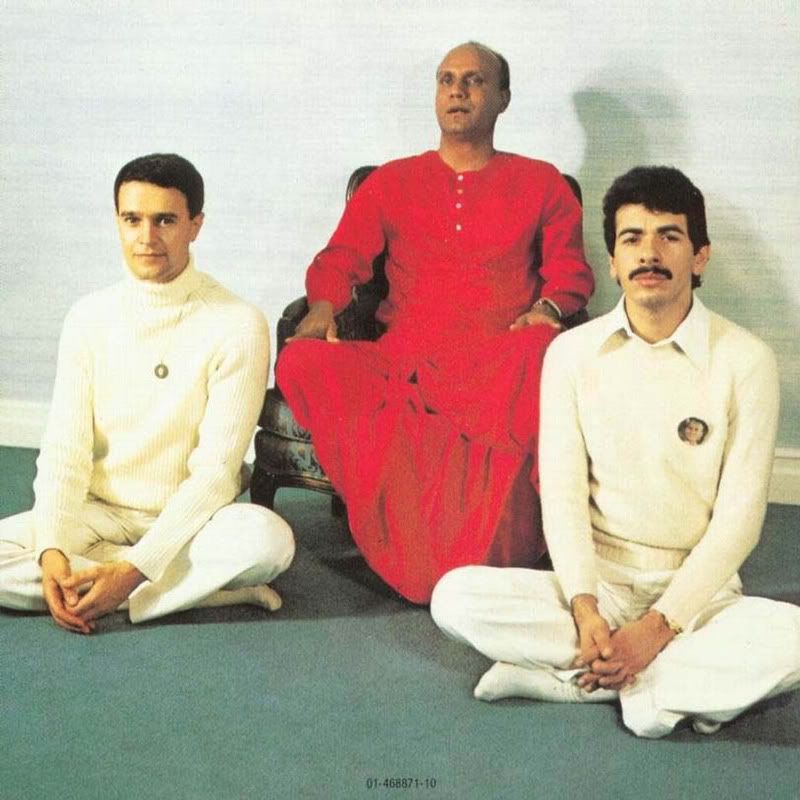
The album Love Devotion Surrender is an example of this cross fertilisation, and is also perhaps the most utterly preposterous record I possess. A collaboration between 'Mahavishnu' John McLaughlin, who was there at the accursed birth of the fusion monster, playing on 'In A Silent Way' and with Tony Williams' Lifetime, and 'Devadip' (yes, that's right) Carlos Santana, who has been eating out on just one good record since 1970. At this point they were both under the sway of Guru Sri Chinmoy, one of those charming chaps who earn money out of warm and fuzzy world-peace platitudes. Essentially the album is Santana guesting as part of the Mahavishnu Orchestra, the big bad fusion daddies that we mentioned previously, although Larry Young and one or two of Santana's friends are also there.
The album is an early example of a genre that has become bloated and saggy with age and cliche, the John Coltrane tribute album. Even worse, this is a Love Supreme tribute album. Even worse, this goes all the way; from the very moment that the album begins you are assaulted with the sound of six musicians simultaneously practicing their scales at hideous volume, a direct lift from the late '60s collective horn improv method, Meditations or Ascension. Once it calms down somewhat, the rim-shots from the drums and the unmistakeable bassline let one know that this is a cover, a mimicking of the first section of Love Supreme. A little crass, you might say, taking Coltrane's 'It takes six hours of practice and at least as much religious study just to get me through one day without smack' epic confessional and treating it as a standard a la All the Things You Are. but then, subtlety is not this album's strongpoint, especially when the boys start half-heartedly chanting a few minutes into their machine gun guitar jam.
Naima comes next, a much more sedate achievement, but Santana seems so spiritually energised that he displays an interesting and irritating approach to long notes - just spewing them out as demisemiquavers, a habit that always seems to always trouble fusion guitarists when they pick up an acoustic. We've yet to hear somebody sing through a field of rolled 'r's, we don't see why guitarists need to play like that.
Track three; 'The Life Divine' is truly, truly mad. After a shimmering organ introduction Billy Cobham batters the shit out of his drum-kit, setting up a high tempo assault of percussion, onto which is laid a strangely charming descending minor chord sequence. This odd juxtaposition of brutality and prettiness then has the utter life soloed out of it by the two guitarists, all the while accompanied by hilariously unsubtle chanted couplets such as "the life divine... will always shine". Santana serves us with his offering first, which is gently melodic, interspersed with the usual screeching imitations of the cries of saxophones. It is worthwhile noting that Santana never leaves the home key - nearly all of his solo is built from the good old dorian scale, which contrasts with McLaughlin's more scholarly interpretation of the Coltrane ethos, reflecting their respective backgrounds in Rock and Jazz. Long, long lines predominate, no melody needs to be delineated by breaths, and so the solos go on, and on, and on, until eventually the song just fades away, as if they all just soloed on long into the night...
Oh well, we suppose that there was a market for this stuff at the time, and that it is born out of a sincere attempt to communicate some kind of spiritual message about love, yeah? but this genre gives rise to a terribly skewed notion of what virtuosity is and what it is for, one that has had repercussions in popular music to this day, resulting in the truism of 'this is why punk happened'. It is strange; the late '60s produced such fantastic jazz, from the chamber sophistication of the Davis Quintet, to the masterful madness of late Coltrane, to the intellectual and political work of his proteges, like Archie Shepp or Marion Brown, and all the other exciting music, yet it's strange that the intentions of the mainstream of this music could deteriorate so quickly, resulting in such utter pap as was generated over the next decade. And where the '60s had the marvelous record designs of Blue Note, Impulse! and other such labels,in the '70s the aesthetic degenerated, as well as the clothes, beards, sunglasses etc... It seems that these jazz musicians failed to realise that the trousers worn were as much a part of the success of a pop act as the sounds that were made, and that this is not necessarily a bad thing.
Sunday, 2 November 2008
Last Exit / Sonny Sharrock
Last Exit are the truth of the Mahavishnu Orchestra.
I wonder if we get any points for noticing that DJ Shadow sampled Sonny Sharrock's '27th Day', from 'Monkey-Pockie-Boo' on the track 'Napalm Brain/Scatter Brain'?
Thought not.
p.s.- this video seems to get very Christian Marclay-y at the very end.
Tuesday, 30 September 2008
Miniature I
I know you're supposed to have footage of yourself in your bedroom when you do this, but sod off... This is a thematic improvisation from a few weeks ago.
Subscribe to:
Posts (Atom)