
Tuesday, 19 August 2008
Krapp's Ghosts
By now, we should all know that the hauntological is concerned with the voice, and its inherent disembodiment. One’s voice is always uncanny, and never more so than when it is reproduced. Ghosts have always used the latest technology when communicating from beyond the grave – before the telephone became ubiquitous, séances were more likely to involve written correspondence. Proust, referring to the first time he speaks to his grandmother over the phone, writes;
‘I cried out, “Grandmother! Grandmother!,” and I wanted to kiss her; but all that I had beside me was her voice, a ghost as bodiless as the one that would perhaps come back and visit me when my grandmother was dead.’
Derrida notes the alienation, or specifically, the spectralisation of the subject as it is replicated through what he calls ‘tele-technological media’. We shouldn’t forget that photographs ‘steal the soul’, as well. The reproduction of the image or the sound of a subject are ubiquitous now, but always spectral, and these concerns we have with ‘the voice’ as an uncanny part of us serve to highlight problematic points of subjectivity, where the illusion of singularity cannot be maintained. Specifically, hauntology is, of course, the fact of being-as-ghost, being as not-present presence. Perhaps we can understand this as an effect that is generated by the friction of our material mortality against the un-dead drive.
This spectral encounter with the disembodied voice is expertly examined in Samuel Beckett’s 1958 play; ‘Krapp’s Last Tape’. The play has one character, Krapp, visiting his special place at some unspecified birthday towards the end of his life, designated as being in the future. Krapp is a splintered character, spread across numerous temporal locations, his physical presence before the audience accompanied by various recordings of his voice made at different stages of his life. He searches out these recordings from drawers full of labelled spools, he listens to them and engages in cross-temporal conversations, mocking and cursing his past self for his arrogance, his ambitions, and his hope in the power of art;
Krapp: Just been listening to that stupid bastard I took myself for thirty years ago, hard to believe I was ever as bad as that. Thank God that’s all done with anyway.
Some of the experiences described by the past Krapp are identifiable as actual events from Beckett’s life, and he uses them as vehicles to investigate the familiar tropes of memory and its uncontrollable nature. Krapp listens to himself describing his awaiting the death of his mother, and how the most vivid memory of the scene is the inconsequential black ball in the mouth of a small dog that he played with as the curtain was drawn in his mother’s death chamber. He also describes a revelatory episode upon a sea cliff, when he understood what the true direction of his art was to be. Old Krapp is disgusted by the fervour with which the past Krapp speaks here, and speeds past in search of something else, a moment of calm with a past lover, drifting upon a boat.
The hauntology of Krapp’s Last Tape is primarily a system of memory, dyschronia and nostalgia. When Krapp listens to his previous tapes we see him encountering two versions of the memory; the memory as recounted by his past self and that same memory as altered by the intervening time between the recording and the listening. Desperately engaging in a synthetic Proustian search, trying to voluntarily grasp at memory but finding it ever elusive, shifting and ghostly, dissipating in his grasp and mocking him interminably. The multiplicity of the voice, with directions that the recorded voice should be ‘strong, pompous, clearly Krapp’s at a much earlier time’ attests to the technological uncanny, as the audience sit listening along with an actor whose lips are motionless to the actor’s own disembodied voice. In amongst this out-of-joint-ness, Beckett tests the power and purpose of nostalgia. When Krapp recalls from amongst the bitterness a moment of love he is struck dumb, his ‘present’ voice is annulled;
-we drifted among the flags and stuck. The way they went down, sighing, before the stem! [Pause.] I lay down beside her with my face in her breasts and my hand on her. We lay there without moving. But under us all moved, and moved us, gently, up and down, and from side to side.
[Pause. Krapp’s lips move. No sound.]
Past midnight. Never knew such silence.
What is happening here as Krapp is silenced by himself, the voice that cannot but go on is momentarily struck dumb. This is such a rare occurance in Beckett that it’s worth trying to understand a little better. At first it seems that the only thing that can silence Krapp, that can break his incessant speech, spread across time and across his spectralised subjectivity is an encounter with the Other, represented by the figure of Love. This is Badiou’s reading: The encounter with Love permits access to the pure multiplicity of being, if only momentarily, freeing the subject from the ‘tortuous cogito’. This would be an example of what we could call a ‘Love Event’, the Beckettian subject freed from speech for a moment. This is tempting, but I’d like to hazard another, slightly different reading; Badiou doesn’t clarify at what temporal level this event occurs, is the silence itself the fidelity to a previous event, or is it the event itself as nominated through the act of a critical nostalgia? But is the dumbfounded silence that Krapp leaves himself in at the end of the play not a similar but opposite aporetic condition to the inability to stop speaking? For that moment Krapp encounters the realisation, by passing through nostalgia, by exhausting the memory, that the voice, the incessant voice doesn’t even belong to him anyway. By this I mean that his scouring of the past leads him to the understanding that the original tortuous aporia, ‘I can’t go on, I’ll go on’, of course involves the stability of the ‘I’. By engaging with his own ghosts, I think that Krapp is silenced by encountering the ghostly core of his own subjectivity; He is haunted by himself.

Wednesday, 13 August 2008
Sadness (part I)
It's a little embarrassing, but this video has everything a hauntologist could possibly want - ruins, archives, scholars, ghosts, melancholy, dust, french, panpipes...
Monday, 11 August 2008
Lovely Penguins

In response to Owen, I thought I'd point out one of my two favourite penguin covers (the other being Beckett's 'Malone Dies', black cover with grey type and a Giacometti skull drawing, of which I cannot find an image). Technically this one is a Pelican, but I think that's actually more appropriate to the discussion. The two main bits of information I can remember from 'Dying' are that a) only a very small proportion of people properly gain consciousness on the day that they actually die, and that b) generally the most physically distressing thing about dying is the difficulty in breathing that comes near the end.
Hooray for egalitarian educationalism!
BBC demands (I)
If I was part of the takeover of the BBC, I would ensure that Werner Herzog replaced David Attenborough as the human face of nature TV. We need more family programmes about the 'harmony of overwhelming and collective murder' on at six o'clock on a sunday afternoon.

Friday, 25 July 2008
Wednesday, 23 July 2008
What does it do then?

as seen on the invite to an event at the pavilion:
"The Serpentine Gallery Pavilion designed by Frank Gehry is an open structure, so please dress accordingly. Due to the unique architecture some tickets may have restricted sightlines."
riiiiiiiiiiiiiight.
Friday, 18 July 2008
Springburn Winter Gardens
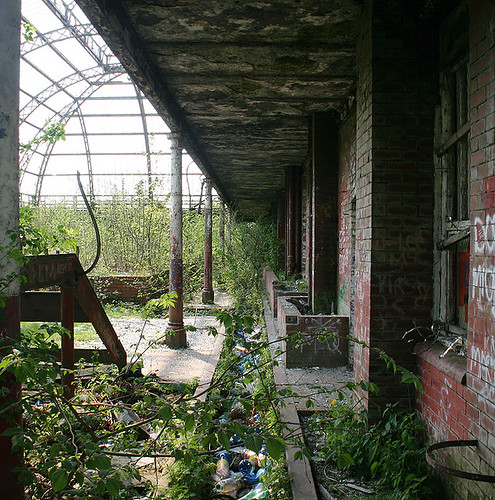
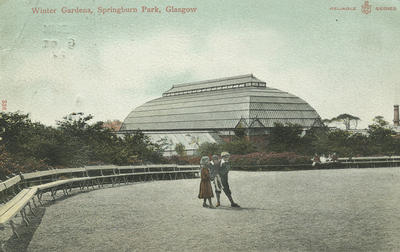
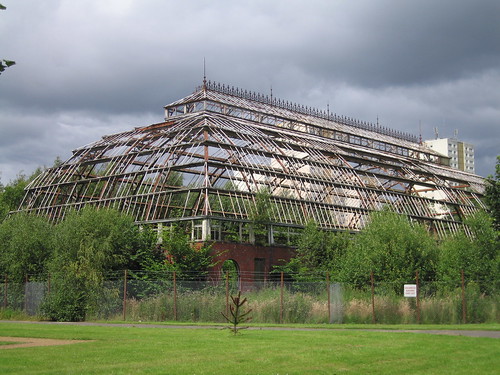
My father's family are from Springburn, in Glasgow. As part of an ongoing homeward visit, we took a quick trip up, and as part of my new role as a self-styled expert in exhibition palaces I was forced to take a better look at this building, which has been derelict for as long as I've had memories. I was especially drawn to it as it bears an uncanny resemblance to the Albert Palace, my own personal lost palace as it were, which was demolished in 1892, the year that this particular palace was built.
in 1922-
in 1971-

recently-
Wednesday, 16 July 2008
More sighs...
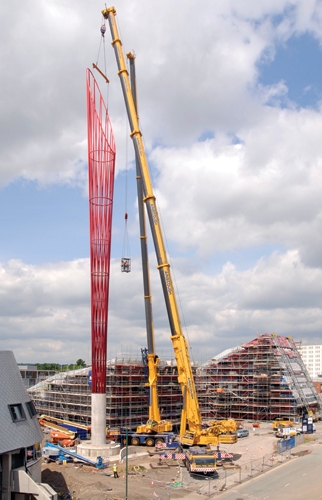
MAKE architects have just completed the UK's largest public sculpture, which is 60m high, and sits in the new Jubilee campus of Nottingham University (the same university that doesn't mind students being arrested and held for a week without charge, don't forget).
The sculpture has a number of traits that make it exemplary of contemporary public art, or 'culture architecture'.
It has a symbolic height.
As seen in projects such as Danny Libeskind's 'Freedom Tower', the symbolic height (or the symbolic angle, or symbolic line, or symbolic shadow, or symbolic cladding etc...) is a feature of contemporary architecture that only exists within the P.R. space of the work. People are generally not good judges of exactly how high something is, so the significant height is only useful if there's a plaque beneath the object, telling you exactly how the work is to be interpreted. It is however useful in a presentation to the client or the planners, who have to make a decision between various different flavours of the same architectural shit. There's a definite cultural aversion to the idea that the viewer/user might be able to use their imagination and make their own associations and connections with an object in space, for example, the Jewish Museum in Berlin is festooned with cards and panels telling you exactly what the uncomfortably sloping floor is supposed to remind you of, and what you should be thinking about that. This is fair enough for Libeskind and a building of such cultural weight, but on the other hand, the Scottish Parliament in Edinburgh has exactly the same issues, which goes a long way to ruining the experience of what is a building deeply concerned with the imaginative response of the user, with someone constantly informing you that "we believe that Enric Miralles was thinking about shortbread when he designed that bench over there, and those light fittings, we think, represent a haggis". This corporate symbolism is everywhere - cladding materials that 'represent' the absent industry of a site, everything has to represent some kind of 'value'. Even in this current project, MAKE talk about 'the theme of nature being drawn through the site', primarily because there are two ponds nearby. This method of minimal 'referentiality' should be compared to the naively heroic abstraction of postwar public art and architecture, with the positive universality of their solutions, and should be seen as an entirely vacuous gesture of lending what are negatively generic solutions the veneer of a contextual relationship.
It is the tallest sculpture in the UK.
Until the next one is built, that is. In fact, there is a hilarious page on the website devoted to the project which allows you to compare the size of the sculpture against a series of (smaller) sculptures from across the world. It's not as big as this though.

It's 'iconic'.
And we all know what that means.
It is funded privately, rather than by the university or the state.
In fact, in a hilarious return of Victorian values, it's been funded by an anonymous philanthropist.
It is called 'Aspire'.
Now this is not just appallingly bad nu-speak, but it's a vile pun that takes on even more of a stench considering it was chosen in a public vote of students and staff at the university. The sculpture sits in a campus that is home to computing, education and business studies, (probably soon having a department of studies studies I imagine), and the name, rather than evoking some noble human spirit of endeavour and self-betterment, is actually much more like a barked ideological order - like ENJOY in the millenium dome, the spatial imperative is to ASPIRE! WANT! ACHIEVE! GET!
It's only fitting that what is essentially a very large, shiny column that supports nothing is considered the best physical evocation of the spirit of contemporary higher education.
Wednesday, 2 July 2008
Wibble Wobble

Dear Reader,
If you were to visit this webpage you would find a grossly hyperbolic article about a work of sound, recently created by ourselves for Bompas and Parr's architectural jelly banquet, to be held at the UCL quad on friday the 4th of July. You may also have heard said sounds on radio 4's "Today" programme this morning.
Yours oscillatorically,
E&V.
UPDATE- Thursday 3rd saw E&V featured in the Times on page 5, and here is another mention (and listenable 'movement').
Subscribe to:
Posts (Atom)