Dear reader, tonight I have been mostly listening to Mark 'K-Punk' Fisher's mix for Pontone. I really cannot recommend it enough. It's stuffed with tracks from the likes of the Caretaker, Black to Comm, William Basinski and Philip Jeck, and it features a track by Asher, who I had never heard of before tonight but now am VERY interested in.
I suppose you might want to listen to this alongside the mix that Kode9 and Burial did for Mary Anne Hobbs' last show at the BBC a week ago, which, if you can find it, is excellent. Mark's mix is of course firmly within the aesthetic of hauntology, but if anybody is allowed to do hauntological mixes then it's the very man who resurrected(!) the term... Here's what he has to say:
What you hear in a recording is not there. It is a spectre. You always hear more and less than was ‘there’ at the time and place of the recording. With vinyl records, the more that you often hear is crackle, the sound of the material surface of the playback medium. When vinyl was ostensibly superseded by digital playback systems – which seem to be sonically ’invisible’ - many producers were drawn towards crackle, the material signature of that supposedly obsolete technology. Crackle disrupts presence in multiple ways: first by reminding us of the material processes of recording and playback, second by connoting a broken sense of time, and third by veiling the official ‘signal’ of the record in noise. For crackle is of course a noise in its right, a ground become a figure. Listen to it for a while and you start to hear patterns; you become susceptible to audio hallucinations.
So, I really haven't written anything of length for a long time on here. This is puzzling, and of course disconcerting. I started writing something about Chris Petit's incredible 'Content', but it stalled. It's a film which you really ought to see, if you're the sort of person who might hang around here on this blog. It is a work firmly located within the 'Architectural Melancholy' mode, experimental and haunting. I let out a sigh when reading the description of Petit as a "lugubrious aesthete fixated with the increasing intangibility of a post-industrial world" in Owen's Icon review, it seemed so tailor made to the E&V sensibility. If I can drag my fingers to the keys properly, then I'll write up the full length thing, which was to be about investigating Petit (and Ian Penman, who collaborates in 'Content') attitude to the spectrality and loneliness of the internet, the yawning absence of a true modernity, and the troubling form of the distribution sheds. In the manuscript wot I just wrote, I touch upon the distribution sheds in terms of their resemblance to hi-tech architecture, but I never really investigate further. But if I'm serious about an 'ugly functionalism', or the 'fantastic dreariness' of Cedric Price, then I'll need to tease out some kind of meaning from these objects.
I haven't been writing quite so much outside of the blog either, although at the moment I'm fairly busy with a few interviews and even a forthcoming cross-european visit to write about a new building, which is either a work of solutionist charlatanry or perhaps the first time someone's done something new with the housing estate in a long time. There might be a few more public appearances and drips & drabs of teaching, which I'll tell you about in due course. And, if you need someone to write, I can wrote proper good word.
But I have actually been reading a lot - blogs even. My Google Reader list has been getting quite large, and actually quite depressing. Day after day certain websites throw another twenty or so press releases out into the world, a seemingly endless stream of quite-ok work, which you either like or you don't, before promptly forgetting about it seconds later. I remember the thrill of the very early days of file sharing (Napster, Audiogalaxy, that kind of thing) where two regimes of cultural accumulation overlapped for a while - the genuine joy of finding something rare, something you might have heard about but never been able to find, and the sudden abundance of anything and everything. Nowadays of course the very notion of rare culture is disappearing. We might call it democratic, but there is of course a deadening of mystery that comes from this accessibility. If we know anything about desire it is that its easy and immediate satisfaction is not particularly healthy. Or maybe I'm just losing my edge. I've also been reading more novels recently. After going through the ordeal that was 'The Kindly Ones' I'm currently reading Lanark, which has managed already to be very moving. It's such a strange feeling to be reading about Glasgow from the perspective of an exile, albeit one only six hours away by train, but today it was so very very strange to be reading Gray's quasi-autobiographical description of attending the Glasgow School of Art. Although he's describing the '50s, it didn't stop floods and floods of my own memories hammering down on me like the storm that was battering my train carriage as I read.
Music is another thing that has been keeping me from writing here recently, although a wounded index finger had put a stop to that for a while. You might have had a listen to my Wagner / Iron & Glass thing the other day, and most of what I've been playing has been along those lines, although it has been a mixed bag. I'll probably start trying to record more of these pieces, if only to document the quite possibly 100+ nearly-finished arrangements that I've got sitting around. I suspect that most of the people who read my architecture stuff aren't particularly interested in German Late Romantic music being played badly on an instrument to which it is not suited, but those are the perils of the self-published internet after all. Which brings me to...
I must say that I nearly jumped out of my skin when heard about this record, and came minutes away from getting it on vinyl, despite not being a DJ, or having a turntable in my room. I'm not a huge fan of Matthew Herbert, although I appreciate his conceptual approach to music making. I generally find some of his dance/pop music to be a little bit twee at times in its mannered funkiness. But an album, part of Deutsche Grammophon's Recomposed series, that digitally re-imagines Mahler's Tenth Symphony? Mein Gott! It's almost as if they had made it just for me! So: what is it? It's basically a recording of the Adagio first movement of the tenth symphony, acoustically situated. The only aspect of it that is recorded anew is at the beginning, which features the opening melody played on a single viola, apparently at the composer's graveside. Over the course of the next forty minutes or so, recordings of the piece are played into various acoustic settings - notably the inside a coffin and behind the curtain at a crematorium. All of the conceptual re-recordings in some way relate to Mahler's death-fixation, which is an over-stressed theme, but did of course exist. Each re-recording changes the acoustic qualities of the record, sometimes sounding tinny, occasionally as if it's underwater. You can sometimes hear vehicles and animals in the distance. In this sense it relates strongly to Gavin Bryar's "The Sinking of the Titanic", which conceptually recreates various acoustic properties derived from the story of the Titanic and the performance of 'Nearer My God to Thee' which supposedly continued as the band sank with the ship. Unfortunately some of the Herbert recording works well, while some of it doesn't. When the piece has the high frequencies lopped-off, and one can hear the sounds of rain, it's a successful example of some of the things that I try to achieve when I write music. But when Herbert takes the gigantic 9-note chord from late in the movement, his way of destroying seems underwhelming; a throbbing noise over a rat-a-tat-tat rhythm that fails to live up to the expanded palette that Herbert seems so keen to achieve. It also seems strange that Herbert has steered clear of hauntological territory here; he's surely not unaware of that now rather distended genre, which at its best in, say, Philip Jeck, is some of the most conceptually interesting and yet also gut-wrenchingly moving music of the last decade, but that also has the capacity to lapse into the decay-chic Wagner of Indignant Senility. But Bryars, who worked with Jeck on the most recent recording of 'Sinking of the Titanic' seems to have appreciated the resonances of crackle, of decayed media, of haunted sounds, while Herbert's is remarkably clean, mannered. It just seems that a lot more could have been done with this record - they should have gotten me to do it!
So I wrote something about The Kindly Ones which harked back to something Spillway wrote about it, and now The New Ennui has written something about it too.
I must say that in the aftermath of reading the book I read a little more history, not only about the massacres that are depicted in the novel (and thinking of the visit I made to Auschwitz-Birkenau ten years ago, where I was utterly disgusted by the group of Americans taking photos. and yet myself wandered around dumfounded and confused, unable to grasp any meaning in the rubble), but also about the Nazis who were shot for helping Jews to escape, or the officers who attempted to use their aryan good looks as a way to get close enough to Hitler to kill him in a suicide bomb attack. Perhaps the underlying and terrifying insinuation that the novel communicates so well is that you, me, almost everyone, would attempt to find a way to deal with the situation without putting themselves at risk. This also reflects badly on the pervasive narrative of 'pure evil' and 'pure innocence' that perhaps is not the way one should be memorialising the period as it passes out of living memory. I suppose, also, that this enquiry might lead one back to Sartre and freedom.
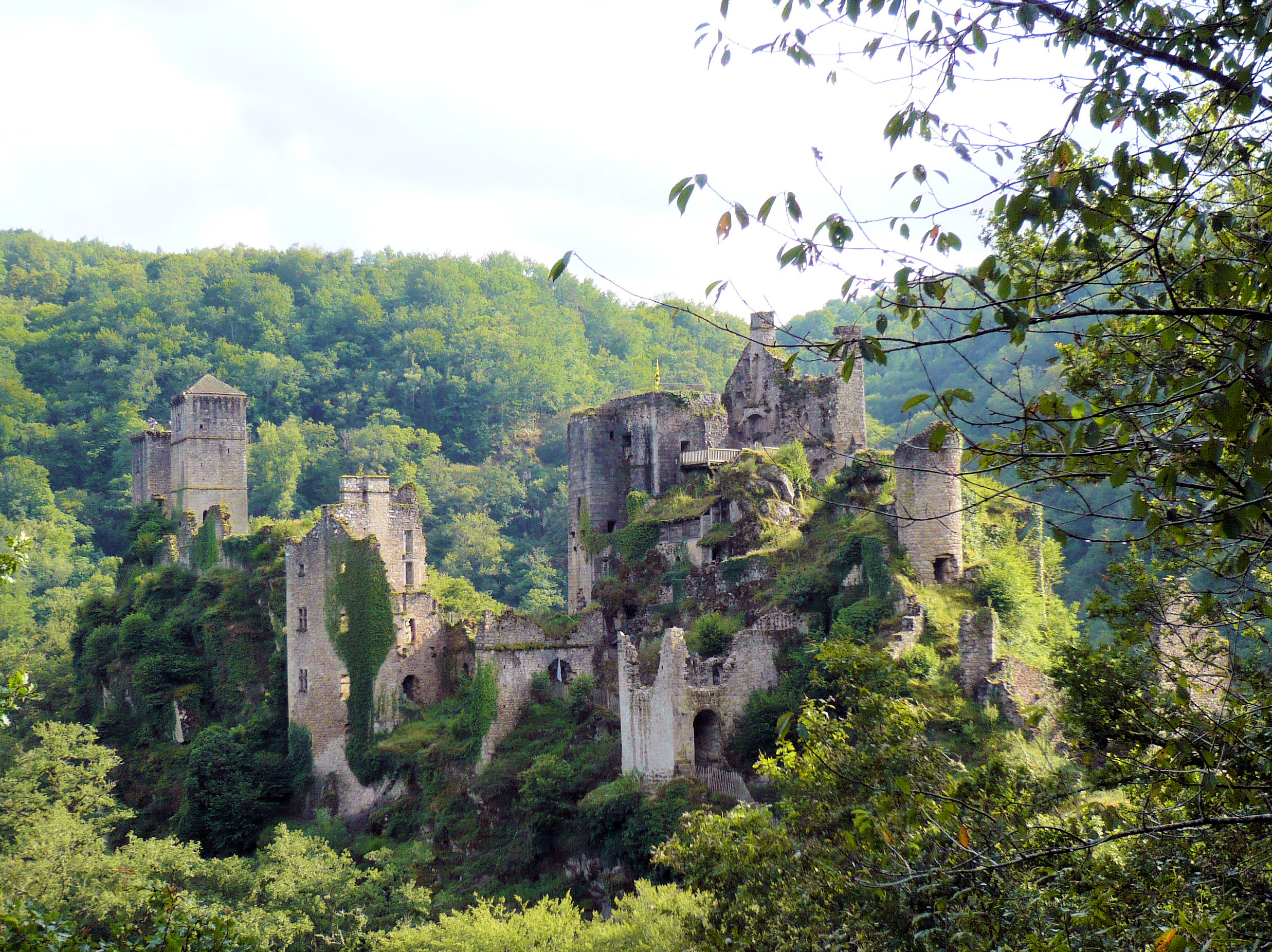
So, on my recent trip to France I was hunting for postcards, and I saw this, at which point I turned into a little spoilt brat and began begging my friends: "Please! Please! Can we go? Can we? PLEEEEEAAAAASSE!!!!??!?!" So we went, and it was a great day out.
The ruins in question are the Tours de Merle, a 13th century citadel that played a role in the 100 Years War but were gradually abandoned after its strategic significance waned.
Here's a few brief notes on a somewhat-less-than-cheery book I read while I was away, Jonathan Littel's The Kindly Ones. I know one person who has read this, so would perhaps like to discuss, but for the rest of you this will probably be not much fun. I'm also going to be spoiling it, so beware...
Forrest Gump in the Holocaust One thing that struck me about the structure of TKO is that it in a way mirrors the construction of Forrest Gump, that mawkish and generally bollocks film that cleared up at the Oscars all those moons ago. You'll remember the premise: Forrest Gump, a man who suffers from an unspecified learning difficulty, manages to 'find' himself in all manner of significant moments in American history, through sheer accident and serendipity. Well, Littel has done something very similar here. Max Aue, the protagonist of TKO, 'finds' himself at a number of the very most infamous moments of the Second World War. He attends the Babi Yar massacre, he is trapped with the Sixth Army in Stalingrad, and he is right there in the 'Final Solution', among other events. Littel's planning is immaculate: the research he put into the book is famous, and it has been praised for its 'accuracy', if such a term is praise in this case. But it's a similar premise to Gump - playing with events that the reader will presumably know about, while tying them together with crushing detail that swamps the reader, all the while throwing in a number of knowing asides referring to this process.
Ulysses in the Holocaust Another obvious comparison to be made is that between TKO and Joyce's Ulysses. The two novels, both massive, are structured around texts from Greek literature. Where Joyce used the Odyssey, Littel uses The Eumenides. Both of the novels create a kind of representational matrix around their fastidious historical accuracy, with scenes and characters specifically the correspondents of their classical template. But the differences are almost mirror-like. Whereas Joyce took an epic poem and used it to signify heroism within the quotidian and the mundane, Littel uses a tragedy, and somehow evokes the crushing banality of ultimate human horror and suffering. Both also manage to use boredom, and boring the reader, as powerful tools. The way the initial horror the reader feels at the massacres and murders that Aue witnesses, supervises and takes part in slowly fades to a consistent rumble of terror is frightening precisely because it's easy to think that this might be how it works for those committing terror; one latches onto details and routines, as the incessant roar of death and misery becomes featureless and constant. On the other hand, some of the characters that Littel uses to correspond to his classical model (such as the two policemen) seem superfluous, crammed in for the sake of structure.
Magic Realism in the Holocaust For many reasons I thought TKO was a far better novel than 'Everything is Illuminated', upon which so much praise is lavished. Indeed, after TKO, one finds Safran-Foer's whimsical magic realism a little harsh, cynical. Although the terror described by EiI is powerful and harrowing, it's also mawkish and sentimental, and seems in retrospect to be somewhat lightweight, despite its genuine horror.
Sex-dreams in the Holocaust, But this brings me onto another thing, something that at first annoyed me about TKO, but later I found more ambiguous, confusing. Aue is a bureaucrat par excellance, a taker of notes, a writer of reports, a ticker of boxes. In many ways he embodies the stereotype of Nazi evil, and in a way it is only his cultured bourgeois attitude, and his tragic family story that raise the character out of the sterility of the Eichmann stereotype (although of course Eichmann is a major character in the novel). But although until about half-way through the novel the detail is horrific and drab at the same time, before long fantasy begins to make its presence felt. Long hallucinatory passages start appearing, often related to starvation and weakness. At first I was put in mind of Sartre's 'Iron in the Soul', which features a long hallucinatory sequence as one of the characters starves in a prisoner-of-war camp. But beyond that, and once the dreams and fantasies start to become hyper-sexual, it was 'Gravity's Rainbow' that really came to mind. GR is, from start to finish, dream-like and fantastic, and luridly sexual. But this is a consistent trajectory of that novel, whereas in TKO it often feels like an intruder into the lucid and dry bureaucratic side of the novel. Of course this is the point, but there's different ways I can read that: either it's a way of making things happen in the novel (Aue's escape from Stalingrad is a little convenient for my liking), in which case it's a weakness. On the other hand, the difference in register between Aue's increasingly numb reaction to what is going on around him, and the increasing hysteria of his dreams and fantasies, might be read as a pessimistic admission that not even a catastrophe of that scale can take one away from one's own psyche, one's own neuroses. Or perhaps, on the other hand, Littel is trying to make a strange and minor redemptive point, that horror of such scale is not something that can be coasted through, numbly, and that the mental disintegration is to be understood as probable and another level of accuracy. By the end of TKO, one is never sure if anything is actually happening at all, what with Aue having such a tenuous grip on reality. Indeed, the only things holding the novel together at all are the dates, the details that Littel has been so careful with; History.
There will be nothing on here for the next two weeks as I'm taking what feels like a well-earned break. In the meantime, here's a recording I made of my own arrangement of Wagner's 'Im Treibhaus' from the Wesendonck Lieder, as mentioned previously here.
I'm slightly pleased with having done an arrangement of this piece, if only for the fact that a German Romantic lied about being melancholy in a greenhouse more or less covers all of what I've been talking about for the last year or two. Add to that the sheer morose joy of the repeated iv-i-iv-i (in minor, of course) and you have hopefully enough to temporarily fill the 'desolate, empty, horrible void' of my absence(!)
Since graduating I have worked freelance on a couple of competitions, but nothing that I have initiated myself. Seeing as the windows of opportunity are being slowly and consistently reduced to mere archery slits, a young practitioner such as myself should probably be a lot more keen, entering things willy-nilly with nothing to recommend me but a charming grin and a willingness to work for anyone on anything. Although this is obviously only a route that an ambitious little shit would ever take (although there's never in the history of humanity been a shortage of those, oh no...) I am getting the strange feeling that I ought not to just sit at desks slagging everything that everyone does all of the time.
Now, disregarding the obvious hypocrisy, I thought I would share this - It's a competition to 're-imagine' one of the World's Most Insane Buildings - The Palais de Justice in Brussels. If you ever wanted to understand the architectural and cultural context into which spaces such as the Crystal Palace or the winter garden in general were arriving, then you really have to look at this behemoth, the largest building built anywhere in the 19th century. An eclectic smorgasbord of folderol; a steroidal, syphilitic architecture...
Not that long ago (6th of April to be precise), I wrote a short piece poking fun at the ArcelorMittal Orbit, that contemptuously half baked excuse for an Olympic landmark. Recently, the planning applications for the 'Mittalintestine' were submitted, which of course gave us more information than we had before (You can have a look through here...) I won't go into too much detail, because there's very little revelation of poor design concepts and half-baked aesthetic justification that wasn't abundantly clear from the outset of the project.
But actually, there are a couple of things that made me laugh in a mixture of pride and shame, at my having predicted so thoroughly the mindset of those involved. I made a couple of mentions in the previous post to the 'napkin sketch' and the notion that Anish Kapoor provided his ideas only at the very beginning of the process, before it got taken over by the wibble engineers. And lo and behold, the concept sketches as revealed in the Design and Access statement are the sort of piss-poor doodles that would be torn off the wall at any review in any art school, anywhere in the world, for wasting your tutor's time, your fellow students' time and of course your own bloody time. But no, in this case they reveal genius at work. Of course.
The other thing, which I find even more appalling, is that I basically preempted their whole rationalisation spiel. Here's what I wrote about my 20 minute cock'n'balls redesign, as seen above:
I think it not only provides an iconic structure that we can all admire from anywhere around London, but it also wryly subverts, deconstructs, if you will, the priapic certainty of the conventional tower-structure.
And here's the genius artist & genius engineer:
The design for ‘Orbit’ evolved out of a dialogue between Anish Kapoor and Cecil Balmond. They have been working together for over 10 years. The Artists started their creative investigation by looking at the idea of the tower in the 21st century. It should be a landmark sculpture and to be defined as such, it will provide panoramic views over London. Post London 2012 Games, it should retain its iconography against the London skyline. It should make an iconic statement about ‘Tower-ness’. They looked at epoch making towers such as the Eiffel, Tatlin, Empire State and even the Pyramids. They could see that all conventional or classical structures want to accumulate strength and are thus stable ground based structures. Furthermore all towers are continuous in the vertical plane. This was a premise which Kapoor and Balmond wished to unravel and to destabilise.
The ghost of shit sub-Derridean thought continues to haunt aesthetics. Damn them all, the fools.
This is one of those 'Sorry I haven't written anything for ages' posts. Truth is, I've been sooooooooo busy. But in the meantime, here's something for all you Wagnerian furries out there...