Well! Haven't I been a busy boy...
This month you can find me in Blueprint magazine, although perhaps not for a reason you might think. In fact, if their rather spiteful article is to be believed, then apparently I'm one of the 'new establishment'. Although it shouldn't really be dignified with a response, I'll take this opportunity to suggest that I'm available for hire as one of the new establishment! I can write, when I'm not too exhausted of course, and I have a track record of being able to effectively sublimate my navel-gazing misery into pithy architectural critique. Although if anyone can find out where I've written about Zaha's Aquatics Centre, as referenced in the article, then let me know...
Appearance!
I will be speaking this Saturday as part of the Historical Materialism conference. My talk will be about the architectural failure of the last thirteen or so years in British Housing. I currently intend to discuss the future as well, if you can imagine that.
Icon
As usual I'm in Icon, and this month there are literally FIVE pieces by yours truly... The magazine has been redesigned (well I think - borders are the new full-bleeds!), and I really do advise you check it out. I've written about a Japanese house to die in, the Skyroom in Borough, a shelter in the Azores, a sauna in the centre of a Czech reservoir, and most importantly for me, Patrick Keiller's 'Robinson in Ruins'.
I've been very busy recently. I wish I had a better work/work/work balance, but this is how it goes, I suppose.
Until the next time, which I genuinely hope will be soon...

Friday, 12 November 2010

Wednesday, 3 November 2010
Can Architecture Fail Better?

This weekend just passed I spent in Warsaw, in a hotel just on the edge of the massive square under the Palace of Culture. I don't possess a camera these days so there was no way I could really make a documented journey that I could share with you, but of course Owen has already done so rather bloody well. I must say that I really enjoyed my coffee outside of Powisle station, ruminating on certain particularities of Warsaw pact urbanism, which I've picked up in previous travels to Poland, the Czech Republic, East Germany and Slovakia. Such features include the width of the pavements, always generous, the unfussy borders between pavements and grass / shrubbery, and of course the accentuated distance between buildings. Top that all off with a windswept plaza and you're really somewhere.

My reason for being there was a talk to be given at the Museum of Modern Art, which awaits its eventual relocation into a building by Swiss architect Christian Kerez. I've previously interviewed him over the phone, and his English sounds uncannily like that of Werner Herzog's, which was eerie to say the least… I must say I'm impressed with his Warsaw project, which has hints of the best of post-war Brazilian Brutalism, and I hope that when it is realised it is as good a building as it appears in the drawings and renders.
Anyway, I'd like to share with you my notes for the talk, which I ended up kind of ad-libbing in the end. It's an early attempt to push ideas a bit further than they go in my book, but at the same time is a little bit of an elucidation into some of the ideas contained in it. Please forgive the conversational tone.
-------------
As you may have noticed, we are at the current time experiencing a new period of ruinenlust. But the subject of this passion for ruins is modernism; many of the 20th century’s experiments in changing the spatial patterns of politics, aesthetics and life still exist, ever more poignant due to the faded urgency of their expressions of tomorrow. The ruins of modernism figure heavily in the work of contemporary artists such as Jane and Louise Wilson, Cyprien Galliard, Tacita Dean, or Jeremy Millar. To that you should add the new book by Owen Hatherley, and the recent film by Patrick Keiller 'Robinson in Ruins'.
So there are a number of strands of what we might call ruin-thought currently at work. To these I would like to add my own area of research, which in a very clichéd way might be described as a history of the future.
I too am interested in the ruin, but in my research the ruin has cometo signify something more abstract than the abandoned and the decayed. I might be able to talk about the 'abstract ruin', but I think that a better word to describe my research is perhaps the word 'failure'. To me, 'failure' is a word which describes not only its literal meaning, not achieving one's goals etc… but also a certain way of seeing.
One might call it 'urban romanticism' perhaps, or maybe 'architectural melancholy', but it refers to, and is drawn to a certain active repression of negativity in architectural culture, a repression that one can uncover through the examination of fragments. I contend that this constant repression is not only a process of aestheticisation but is also a politically charged repression as well. Hopefully I can give you a few examples here tonight.
I will look at a number of different types of building and discuss ways in which this 'failed' condition appears in them. What I will be trying to tease out is a certain 'radical weakness'.
Iron and glass palaces
I will start from what are often attributed as the very beginning of modern architecture, the iron & glass palaces. Made possible through the development of industrially mass-produced cast-iron and plate glass, these buildings evolved from the construction of small orangeries attached to the sides of aristocratic housing till by the middle of the 19th century they had become the largest enclosed spaces in the world, accommodating massive exhibitions, huge displays of flora, as well as covered shopping streets and railway stations. It is not to exaggerate to say that they accommodated some of the most significant changes in ways of life that were occurring at the time; the birth of consumer capitalist culture, the beginnings of mass transit and mobility.

Perhaps the most famous of these buildings is the Crystal Palace, built in London in 1851 to house the Great Exhibition, which in the words of Prince Albert, was "to give us a true test and a living picture of the point of development at which the whole of mankind has arrived." the Crystal Palace was a gigantic web of mass-produced iron & glass, a vast display cabinet containing over 100,000 exhibits, ranging from industrial machinery to raw materials, from fabrics to furniture. Over 6 million people visited the exhibition in six months, one of the most significant early moments in mass culture.

On the one hand the Great Exhibition was a way of symbolically demonstrating Britain's lead in the industrial race, but at the same time it was an event that was born from elite fears of insurgency; conceived in the wake of the failed European revolutions of 1848 and the Chartists revolt, a fear of the working class was a prominent accompaniment to the exhibition. However, not only did the Exhibition help to placate working class anger, it also united the aristocracy and bourgeoisie behind the banner of free trade, inaugurating a new regime of spectacular capitalism: Walter Benjamin wrote that at the Great Exhibition "the masses, barred from consuming, learned empathy with exchange value".

It is frequently thought of as the definitive example of proto-modernist architecture, the work of an engineer-genius who defined a new language of prefabrication and minimal regularity. Overall these iron & glass buildings ushered in a whole new regime of spatial qualities. Compared to the prevailing mood for beaux-arts eclecticism, massive, monumental, a language belonging to the initiates, the weightlessness and lack of conventional language made these buildings highly controversial. For many there was no way that they could be considered architecture at all, examples of 'mere engineering', unsuitable for existing in cities. Very soon aesthetic cowardice would prevail and iron and glass buildings would be constructed behind monumental masonry facades, (take, for example the 1893 Columbian Exhibition, which marked a return to Beaux-arts aesthetics, and about which the modernist Louis Sullivan would remark: "The damage wrought by the World’s Fair will last for half a century from its date, if not longer")
It is not at all difficult to understand the transition from the great exhibitions on to buildings such as shopping malls and other such vast commercial spaces, but there is far more to them than that.
First of all, there were a number of more utopian views of the Crystal Palace. One can be found in Chernyshevsky’s novel ‘What is to be Done?’. In a celebrated passage the Crystal Palace (which Chernyshevsky visited in 1859) appears to the heroine in a dream; functioning as a symbol of a peaceful socialist future brought about through rationalism and technology. (Later, Tatlin's monument to the third international would be described by the critic Victor Schklovsky as being “made of iron, glass and revolution”) The transparency, lightness and rationalism of iron and glass was seen by many radical critics in the early 20th century as a forward looking counter to the eclectic styles of the bourgeoisie. (See German Expressionism, or Siegfried Giedion etc...)

A less avant-garde attitude was that of the well meaning 19th century concept of 'improvement', whereby the lower classes were to be given access to culture in the hope not only of improving their lot, but also reducing the risk of working-class discontent. When the Crystal Palace was rebuilt after the exhibition was over, its owners were adamant that this massive building would be used as a space for, as described in its charter, "the illustration and advancement of the Arts, Sciences and Manufactures, and the cultivation of a refined taste amongst all classes of the community." Try to imagine a building that housed a massive concert venue (20,000+ capacity), with a series of museum spaces in which various architectural styles were rebuilt and mimicked, along with gardens, displays of art and sculpture as well as an art & engineering school. It basically contained every artistic and cultural activity that you might think of, all contained within a gigantic display case.

But far from the glorious monument it is often remembered as, the Crystal Palace itself lurched from crisis to crisis, never actually living up to its lofty intentions, and never managed to make any money, prompting the following comments:
"Glass, as we know, is an excellent non-conductor of heat; it is possible that it is also a non-conductor of coin & prosperity."
It slowly became dilapidated (like so many other buildings of its kind) and eventually burned down in 1936.
I recall a visit to the Crystal Palace during a summer in the mid 1930’s; it presented a most woe-begone picture, peeling and sun blistered paintwork, the glass grimy, ironwork encrusted with rust and stonework suffering from erosion. Overall was a film of black dust that seemed to invade everywhere.
And against monumentality, weakness is, perhaps, one of the defining characteristics of the palaces and their culture. From the very simple sense that compared to all architecture that had gone before the palaces looked as delicate as a spider’s web, “the most fairy-like production of Architectural Art that had yet been produced" ethereal, almost completely transparent, to the worries before the Great Exhibition that the building would collapse at the first heavy wind, to the very word ‘Crystal’, with its connotations of the fragility of glass, to their susceptibility to fire and collapse, to their pathetic fights against commercial decline, we should stress the strong narratives of weakness that attend the culture of the iron & glass buildings.

Eventually, nearly all the iron and glass buildings of the 19th century were demolished, or were destroyed, victims of neglect and a number of other conditions.
“these buildings vanished from the mental horizon like a fata morgana, like a shimmering soap bubble that could not survive the forces of the times and burst into tiny pieces."
Now, at this point I would like to note various other buildings with these qualities, failed, ruined architectures, bearers of the qualities that couldn't be allowed to happen.
HANNES MEYER'S LEAGUE OF NATIONS PROJECT

Perhaps the next time that a pure aesthetic of this kind would appear would be in the work of the most radical left-wing architects. Takes Hannes Meyer, head of the Bauhaus from 1928-30, who was fired by the fascist mayor of Dessau for donating money to striking workers, and who would design buildings for trade unions as part of a collective practice with his students. His competition entry for the League of Nations (1927, unbuilt) made great play of the egalitarian overtones of modularity and repetitive units; compared to Le Corbusier’s heroic modernist entry to the same competition Meyer’s was rough and full of radical commitment, with a gigantic steel & glass dome over the assembly. Critic Kenneth Frampton makes the connection explicit: referring to Meyer’s radically democratic deployment of prefabricated units and the privileging of process over composition, he wrote that
“All unity is now seen to reside not in some pre-ordained static ideal, as in antiquity, but in process itself, as made manifest through the proliferation of rationalized technique in response to changing need. Hannes Meyer’s design for the League of Nations building of 1927, with its systematic modular assembly of components, clearly intends little else but such a manifestation. In this respect one can hardly overlook its significant derivation as technical method from Paxton’s Crystal Palace." This is a very strong deployment of the aesthetic, naked prefabrication coming to stand as a metaphor for socialist organization.


Now of course the building is crude, and lacks a certain sophistication compared to Le Corbusier's more celebrated entry. But there is a certain charge to the rudimentary grid and its deployment, and considering the function of the building, the political message that would be put across can be seen to be almost unbearable; there is not a political organization that one can imagine that would be able to send the message that their power is prefabricated and generic.
CEDRIC PRICE'S FUN PALACE
British architect Cedric Price was in some ways perhaps the ultimate ‘functionalist’ - he had the required faith in technology and the belief in a changing society, but compared to his contemporaries Buckminster Fuller, Archigram in the UK and the various radial architecture groups at that point, his projects were based on a level of analytical rigour that was a world apart from his fellows.
Price was well known for commitment to indeterminacy, his aversion to style, his absolute rejection of monumentality and detail. Bearing in mind that a non-aesthetic is still an aesthetic, if we examine Price’s built work we can begin to see remarkable parallels with the iron & glass palaces, with their immateriality and their un-ruined dilapidation.


Price’s Aviary at London Zoo (1961-) is a spacious wire tent, so immaterial as to be almost non-existent. Filled with trees, it was intended to be quickly removed once the birds had made their permanent home, but is still standing, dirty yet proud.


His famous ‘Fun Palace’ project is very similar to the system of courts we discussed inside the Sydenham Palace; a minimal superstructure was to be filled with a shifting set of fragmented spaces for various leisure purposes. But while the courts of the Sydenham Palace were nominally static, the Fun Palace was to be structured in such a way that it could be reconfigured at any time. The Fun Palace has become a very significant project, highly popular with those in the art world with a passion for interdisciplinarity or relational aesthetics etc. For this reason I think it's important to not let it be an intellectual plaything of jet-set curators justifying their own patronisingly class-less and whimsical collaborations. In fact, contrary to the repeated injunctions, I think it's vitally important to consider the aesthetics of the fun palace, consider what kind of political and ideological message a building of its kind expresses. In fact, until recently there was an opportunity in London to do just that.


The InterAction Centre (1976-2003) was a scaled down version of the ideas from the Fun Palace. A lightweight and stripped down frame was constructed into which containers and other industrial objects were inserted to create an evolving and adaptable set of activities. Again, the comparisons to iron & glass are telling; the spindle-like frame, the sense of potential for expansion and contraction, the incomplete spaces made up by fragmentary units within, the dirt and grime that collected around the permanently-temporary structure, all these things were visible in the Crystal Palace, while the programmatic concerns of activity & delight were modern versions of the ‘people’s palace’. Price built little, and would probably reject this assessment of his work, but I suggest that what you can see there is an example of what a genuine future would look like, if the revolutionary change of the late ‘60s had been more successful. Dirty but not ruined, dream-like and un-monumental – Fantastically dreary.
BIG SHEDS

Now of course one might see certain tendencies that are currently active; it's true that the exhibition culture of the late 19th century did lead to the shopping mall capitalism, and also true that the culture & fun palaces as described before also provide roots and glimpses of the worldwide phenomenon of the contemporary art museum, There's another, more hidden route that these histories lead forward to. I'd like to talk here about LSSB's, or 'Large Single Story Buildings', or otherwise known as 'Big Sheds'.

These are possibly the most exemplary buildings of contemporary capitalism, functioning as distribution centres for goods. These buildings occupy space with high infrastructural density, and are perhaps the closest things to 'pure' architecture that exist any more. They are very difficult to love, almost entirely lacking in aesthetic reference points, significantly, these structures are almost entirely ignored by the architectural press in a manner that cannot help bring to mind that manner in which iron and glass architecture was ignored. Although they were described by the late British critic Martin Pawley as 'the architecture of the future' in 1998, this was not necessarily a recommendation. These buildings represent some of the only spatial manifestations of globalised capitalism, moments in the networks of container ships, automated container ports and so on. They are rare points where immaterial capitalism 'touches down'.

But if they have been ignored by architects themselves, they have been approached by artists. Patrick Keiller's 1997 film 'Robinson in Space' goes in search of the spatial qualities of contemporary British capitalism, expecting to find decline but instead being confronted with the blank faces of a then-thriving culture. Distribution parks built on former coal mines, the cheapest and most efficient spaces possible. More recently, Chris Petit's film 'Content' (2010) also attempts to aesthetically approach these almost entirely blank spaces. In the words of Petit, the big sheds 'render architecture redundant'. Is it possible to look to these buildings with a similar eye to those that saw fragments of the future in iron & glass?
Tuesday, 26 October 2010
Arcades, melancholy & the late 1930s

Here's a funny thing I noticed the the other day.
By now you should all be aware of this:
Hence, the light that fell from above, through the panes between the iron supports, was dirty and sad.
-Walter Benjamin, Arcades Project, [F1,1] p.150 (1927-40)
But what about this then eh?
The Zwinger [...] is altogether lovely, with such sudden sad passages [arcades] ...
-Samuel Beckett, Letter to Thomas McGreevy, 16/2/37
There are sad passages, the arcades leading up to the entrance on the garden side.
-Samuel Beckett, Letter to Günther Albrecht, 30/3/37
Monday, 25 October 2010
In Praise of the Space Frame!
Is there any structure that quite shouts '1970s' more than the space frame? Under the influence of Rayner Banham and Buckminster Fuller, radical architects all over the UK suddenly turned away from concrete towards the joys of ball-joints and lattice work. lightweight and efficient, these structures also look dirt-cheap, and are magnets for dust and grime. No other structure manages to look quite so dowdy as the space frame. It's almost as if they were designed to evoke Benjamin's 'dirty and sad' reaction to iron & glass.

Warren Chalk (Archigram)

Cedric Price
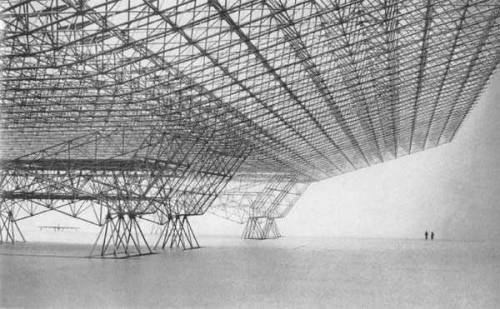
Konrad Wachsmann
Essentially what killed the space frame as a vehicle for architectural expression was British High-Tech. Rather than the willful ugliness of Price or some of the Zoom architects, making a virtue of the rudimentary, Rogers & Foster fetishised the detail, and led us up to the current commercial glass aesthetic that we all know and hate. But wait! What's this?


Is that really Zaha Hadid resurrecting the space frame? Is she subverting the patronage of her Azerbaijani clients by delivering them a dusty, dreary, dream-like interpretation of the old iron & glass palaces of melancholy?
Of course not. It's going to be entirely clad in an unspecific shiny white material, as ever.

meh.
Lost!
At this point I should state that I've not read Jane Jacobs' The Death and Life of Great American Cities. A few months ago there was a sudden outburst of Jacobs-related chat from the local architectural cognoscenti, and there are two excellent, excellent essays relating to her work from Kosmograd and from Spillway, in case you wanted to go over some of the ideas that contemporary critics have about her, rather than her nu-urbanist zealot followers. Kosmograd discusses how her notion of the city cannot possibly make any sense when confronted with the shocking urbanism of the Foxconn factory city in China, and also discusses how the application of ideas from 'death and life' has lead to 'bo-ho theme parks' (and Jesus, if ever you needed a description of where I live, it's that). From there we are only a converted loft away from Richard Florida, and all the seething shit that goes along with that kind of attitude to the city.
Spillway's piece discusses the new-urbanists' aversion to urbanism, their reactionary love of the qualities of the village, and includes the following:
"All cities need sublimity, a touch of holy terror, a defiance of human scale that asserts connection to the greater urban whole."
This cuts to the heart of the matter, although with Will's permission I might read it slightly differently. As far as I can see, at least a significant part of the desire that certain among us express for an urban landscape of sublimity is not just that it represents an egalitarian and more just future of collective living, but also that it represents a desire for everyday life to be artistic, furthermore, for everyday life to be avant-garde. 'To see one's self in a romance' as Keiller recounts, but perhaps the desire for the sublime modernist urban landscape is the desire to live, as it were, dodecaphonically...

...which brings me to this. The Cooper Union school in New York have put on an exhibition of the Robert Moses scheme that got Jacobs so riled up in the first place, the Lower Manhattan Expressway, as visualised at the time by Paul Rudolph, American brutalist extraordinaire. First, a few caveats: it is of course a Good. Thing. that this redevelopment never took place. And of course what would have been built would in no way have resembled the vision as conjured up by Rudolph. But my god! Just look at it! Surely this is one of the great candidates for urban sublimity...


I often imagine what it would be like if the political and economic situation of the world had panned out differently, if there had been no oil crisis, perhaps, or if the will had been there to continue pushing the megastructural experiments to greater heights and complexities. What if the Archigram project had taken off, and a full section of a plug-in city had been built? What if, to maybe drift close to 'and what will be left of them', the 1970s had not ended up in the 1980s, but had stretched out for another 30 years? What if instead of a right-wing reaction there had been a continuous development of certain modernist tendencies? Would there be any difference to life patterns if you lived in a pod house that hadn't been moved in a generation, and the cranes that were designed to drag it around had seized up long ago, the promised nomadism gradually encrusting into sedentary failure? Would there be a qualitative difference to your melancholy if you happened to live in the very future that is so conspicuously absent from our present?
Spillway's piece discusses the new-urbanists' aversion to urbanism, their reactionary love of the qualities of the village, and includes the following:
"All cities need sublimity, a touch of holy terror, a defiance of human scale that asserts connection to the greater urban whole."
This cuts to the heart of the matter, although with Will's permission I might read it slightly differently. As far as I can see, at least a significant part of the desire that certain among us express for an urban landscape of sublimity is not just that it represents an egalitarian and more just future of collective living, but also that it represents a desire for everyday life to be artistic, furthermore, for everyday life to be avant-garde. 'To see one's self in a romance' as Keiller recounts, but perhaps the desire for the sublime modernist urban landscape is the desire to live, as it were, dodecaphonically...

...which brings me to this. The Cooper Union school in New York have put on an exhibition of the Robert Moses scheme that got Jacobs so riled up in the first place, the Lower Manhattan Expressway, as visualised at the time by Paul Rudolph, American brutalist extraordinaire. First, a few caveats: it is of course a Good. Thing. that this redevelopment never took place. And of course what would have been built would in no way have resembled the vision as conjured up by Rudolph. But my god! Just look at it! Surely this is one of the great candidates for urban sublimity...


I often imagine what it would be like if the political and economic situation of the world had panned out differently, if there had been no oil crisis, perhaps, or if the will had been there to continue pushing the megastructural experiments to greater heights and complexities. What if the Archigram project had taken off, and a full section of a plug-in city had been built? What if, to maybe drift close to 'and what will be left of them', the 1970s had not ended up in the 1980s, but had stretched out for another 30 years? What if instead of a right-wing reaction there had been a continuous development of certain modernist tendencies? Would there be any difference to life patterns if you lived in a pod house that hadn't been moved in a generation, and the cranes that were designed to drag it around had seized up long ago, the promised nomadism gradually encrusting into sedentary failure? Would there be a qualitative difference to your melancholy if you happened to live in the very future that is so conspicuously absent from our present?
Sunday, 24 October 2010
Some listening.
Here's a few things that I have been listening to lately. You might enjoy them too.
Marcus Fjellstrom
the disjointed by miasmah
This guy is an excellent composer of original haunted compositions.
Holy Other
A little recording I made recently, with some shockingly anachronistic rubato.
The Fall - Hit the North
This has been a recent favourite after hours in our flat.
Fennesz - Before I Leave
An old favourite of mine.
Thomas Hampson / Leonard Bernstein / Wiener Philharmoniker, Mahler : "Ich bin der welt abhanden gekommen."
Oh! This is so unbelievably lush.
Moseivitch plays Wagner/Liszt
Crackle!
Rudge plays Wagner/Liszt
Crackle!
Salem - King Night
This is what the 'hip cats' are listening to. Personally I reckon this is the only really good track off the album. Disregarding all else, I like the histrionic quality it has.
Kristen Flagstadt - Wagner : Im Treibhaus
Another pinnacle performance, this is most notable for its very slow tempo.
And...
This is an ultimately futile attempt to cheer up.
Marcus Fjellstrom
the disjointed by miasmah
This guy is an excellent composer of original haunted compositions.
Holy Other
Holy Other 'Yr Love' from FAMILY on Vimeo.
Some haunted disco. This, to me, feels like a cross between Decasia and a Burial record.A little recording I made recently, with some shockingly anachronistic rubato.
The Fall - Hit the North
This has been a recent favourite after hours in our flat.
Fennesz - Before I Leave
An old favourite of mine.
Thomas Hampson / Leonard Bernstein / Wiener Philharmoniker, Mahler : "Ich bin der welt abhanden gekommen."
Oh! This is so unbelievably lush.
Moseivitch plays Wagner/Liszt
Crackle!
Rudge plays Wagner/Liszt
Crackle!
Salem - King Night
This is what the 'hip cats' are listening to. Personally I reckon this is the only really good track off the album. Disregarding all else, I like the histrionic quality it has.
Kristen Flagstadt - Wagner : Im Treibhaus
Another pinnacle performance, this is most notable for its very slow tempo.
And...
This is an ultimately futile attempt to cheer up.


Tuesday, 12 October 2010
Worstward Ho!
Nothing much to report, apart from the accelerating downward motion of what Laurie Penny aptly calls 'kamikaze capitalism'. I for one don't really see how we can't be in line for the most ugly of outcomes, considering not only the fact that organised labour is in disarray, but also that we've got an almost 'accelerationist' government in charge. Say what you like about these vicious scum, but they're just the most avant-garde ticket in town.
Anyway; here's some deckchair shuffling.
ICON

You may know that I'm 'architecture correspondent' at Icon magazine. This month there's more of my words than usual: There's a short feature on Ball-Nogues, who are primarily installation designers out in California. They're affiliated with Sci-Arc, and I suppose that what they do is exemplary digital architecture, in the sense that it's humorous, playful, and perhaps most importantly , it's clever without being overwrought. There's also a larger feature about BIG's '8 House', a rather massive 21st century version of a streets-in-the-sky megastructure. Although Bjarke Ingels himself was (perhaps understandably) quite evasive about having his work compared to something like Park Hill or Robin Hood Gardens, the over-arching concern is remarkably similar; the introduction of traditional (or at least regular) patterns of street life into much larger structures and arrangements.

The day trip to Copenhagen was certainly a somewhat depressing one, but basically for reasons of London's continuing malady than anything else. It really is beautiful, all rugged Scandinavian civic architecture (the old stock exchange (pictured) being a particular highlight), the seemingly effortless modernism, the water everywhere, the obviously slight wealth discrepancies compared to the UK, combined with that old cliche of relaxed and healthy looking people cycling everywhere. BIG have a lovely office, even if it's clear that they're as stuffed with over-stretched interns as anywhere in less relaxed parts of the world, but they have a lovely kitchen. Even Ørestad, the brand-new neighbourhood built to the South of Copenhagen, which is still mostly credit-crunched, even this place had a sense of insouciance and life to it. Add to this the accidental stumbling upon an iron and glass winter garden, the sheer thrill of a nearly deserted airport at the end of the day (bringing to mind Mirabele, that great white elephant) and the pleasures of making the acquaintance of a charming fellow traveller, and it was enough of a pleasurable experience to put one into a really foul mood upon return.
BLOGS
Carl at the Impostume has started / is part of a new group blog abut the 70s, which is thus far excellent. There was a recent post about growth and decline, and about how the 70s prefigured much of what we've been hearing about ecological catastrophe in the last 10 years. The following passage is utterly fascinating, and worth mulling over:
Found Objects continues to be excellent, and I was very flattered to see something wot I did pop up on the site. Thanks, (mostly) unknown hauntologists!
I wrote something about Cory Arcangel before, where I noted his ability to tease out the utterly abject side of internet culture. Well, he now has a blog dedicated entirely to 'sorry I haven't posted in a while' blog posts. It's hilarious and abject, which is a delicious combination.
FILM

I've seen Patrick Keiller's new film, 'Robinson in Ruins'. I'm due to write a review of it, but I'll most likely write something on here as well, perhaps at length. It's going to be abject.
TALKS AND WALKS
E&V is due to be doing a bunch of walks and talks in the next couple of months; I'll let you know what happens.
BOOKS
I'm currently reading the correspondence of Samuel Beckett. I feel like I'm 19 again.
Anyway; here's some deckchair shuffling.
ICON

You may know that I'm 'architecture correspondent' at Icon magazine. This month there's more of my words than usual: There's a short feature on Ball-Nogues, who are primarily installation designers out in California. They're affiliated with Sci-Arc, and I suppose that what they do is exemplary digital architecture, in the sense that it's humorous, playful, and perhaps most importantly , it's clever without being overwrought. There's also a larger feature about BIG's '8 House', a rather massive 21st century version of a streets-in-the-sky megastructure. Although Bjarke Ingels himself was (perhaps understandably) quite evasive about having his work compared to something like Park Hill or Robin Hood Gardens, the over-arching concern is remarkably similar; the introduction of traditional (or at least regular) patterns of street life into much larger structures and arrangements.

The day trip to Copenhagen was certainly a somewhat depressing one, but basically for reasons of London's continuing malady than anything else. It really is beautiful, all rugged Scandinavian civic architecture (the old stock exchange (pictured) being a particular highlight), the seemingly effortless modernism, the water everywhere, the obviously slight wealth discrepancies compared to the UK, combined with that old cliche of relaxed and healthy looking people cycling everywhere. BIG have a lovely office, even if it's clear that they're as stuffed with over-stretched interns as anywhere in less relaxed parts of the world, but they have a lovely kitchen. Even Ørestad, the brand-new neighbourhood built to the South of Copenhagen, which is still mostly credit-crunched, even this place had a sense of insouciance and life to it. Add to this the accidental stumbling upon an iron and glass winter garden, the sheer thrill of a nearly deserted airport at the end of the day (bringing to mind Mirabele, that great white elephant) and the pleasures of making the acquaintance of a charming fellow traveller, and it was enough of a pleasurable experience to put one into a really foul mood upon return.
BLOGS
Carl at the Impostume has started / is part of a new group blog abut the 70s, which is thus far excellent. There was a recent post about growth and decline, and about how the 70s prefigured much of what we've been hearing about ecological catastrophe in the last 10 years. The following passage is utterly fascinating, and worth mulling over:
Because of course, the end of growth, and consequent decline, doesn’t need to lead to starvation, anarchy, totalitarianism or genocide. Between a techno-grandiose future of plenty and the apocalypse, there lies a "third way" - decade after decade, century after century, of drab, dilapidated crapness; a distended Seventies stretching over the horizon, where it may only give way to a similarly distended Fifties, and then a Thirties and so on. This is the future most unacceptable to the Western mind, but alas the one it appears most likely to encounter.
Found Objects continues to be excellent, and I was very flattered to see something wot I did pop up on the site. Thanks, (mostly) unknown hauntologists!
I wrote something about Cory Arcangel before, where I noted his ability to tease out the utterly abject side of internet culture. Well, he now has a blog dedicated entirely to 'sorry I haven't posted in a while' blog posts. It's hilarious and abject, which is a delicious combination.
FILM

I've seen Patrick Keiller's new film, 'Robinson in Ruins'. I'm due to write a review of it, but I'll most likely write something on here as well, perhaps at length. It's going to be abject.
TALKS AND WALKS
E&V is due to be doing a bunch of walks and talks in the next couple of months; I'll let you know what happens.
BOOKS
I'm currently reading the correspondence of Samuel Beckett. I feel like I'm 19 again.
Saturday, 25 September 2010
Don't talk to me about life...
Just what is it about robots with mental illnesses?
This is something perhaps for Found Objects.
And of course, don't forget:
It's perhaps not so much a stretch to suggest that there's something particularly romantic and appealing about the prospect of perfect technology becoming melancholic.
This is something perhaps for Found Objects.
And of course, don't forget:
It's perhaps not so much a stretch to suggest that there's something particularly romantic and appealing about the prospect of perfect technology becoming melancholic.
Friday, 17 September 2010
More from the vaults.
This is probably one of the first pieces of music that I recorded when I moved to London. At this point I was listening a lot to the music of Colleen, and was discovering the world of low-key improv that used to be based around the Sound 323 shop that used to sit up in Archway.
Around that time I recorded quite a few of these improvised drone-pieces, which were made by looping up tiny little guitar gestures which would coalesce into a much larger aggregates of sound. Listening back to this recently, and generally thinking about the time of my arrival in the 'Great Wen', what has changed since then and what hasn't; it's quite a painfully nostalgic feeling. And what with the sense that this whole country is currently being driven over the edge of a cliff, then it's quite a difficult time to be feeling enthused about the problem that is London.
(It's also interesting to me that I had an interest in poor quality recording and decayed media for quite a while before ever reading about sonic hauntology, although I was already reasonably well versed in Derrida by that point).
Subscribe to:
Posts (Atom)