Monday, 17 January 2011

What goes around...

... I might have guessed that this would happen, but Graham Harman has apparently heard that I might unsubscribe from his blog! I've actually seen him lecture before, at Goldsmiths a number of years ago, where he spoke about Latour and De Landa, which I remember partially for being a fascinating, if somewhat mechanically delivered paper, and partially for the fact that he was the first (and only) person I ever heard say the word 'catalysis'. I was even at dinner afterwards, but never spoke with Graham, and now probably never will...

Of course, this being the internet, nothing is actually private. So if you're reading this Graham, I'm sorry I was rude. I find your philosophy compelling, and I have frequently encouraged others to read it because I think it's some of the most important work that's going on in philosophy right now.

That said, I don't care much for the pretentions towards iconoclasm that you and others of your milieu often indulge in, and I often find your writing style to be a little exasperating, my 'favourite' example being;

"Having been deeply perturbed by a personal visit to Hiroshima and Nagasaki, I mean no disrespect to the victims and ruined objects of Japan if I say that the same list of objects is destroyed in a different way by the various philosophies of human access. Human-centered philosophy is a Hiroshima of metaphysics"

-Prince of Networks, p.103

But I do agree that with you that style is important even in philosophical writing.

But anyway, you're right of course, you should be able to write whatever you want about whatever you want, as often as you want, and for whatever reason you want, even if an 'icy cynical, black jacketed poseur' (he's right, you know!) like me might often find it banal. So again, I'm sorry for being a 'wraith spreading grey banality everywhere' (have you been stalking me?). So perhaps it's best that you go on being an important philosopher, and I can go on marinating in my own miserable and resentful black bile. Although, maybe one day we can chat about '26-2', Coltrane's reharmonisation of Parker's 'Confirmation' from 'Coltrane's Sound' (and my particular favourite from that album). I'd like that.

Sunday, 16 January 2011

Oval at Café OTO


Well I must say that I enjoyed that little concert. Turning up early in order to secure a table, we had to endure two rather amateur and apologetic support acts before Markus Popp took to the stage. He's actually a rather entertaining figure behind his laptop, pulling faces and pouting along to underlying rhythms that often seem to be his alone, and making rather camp swan-neck shapes with his arms as he fiddles around with his computer and mixer.

My companion was totally correct when he said that the performance reeked of ten years ago (I was certainly left thinking of some of Icarus' work from around 2005), and of course Oval is somewhat of a dinosaur, but if you weren't looking for the new wheel then you would be left properly satisfied by the balance between the soft and the raucous, the rhythmic and the chaotic, the harmonic and the noisy. It was the well composed and considered music of a developed artist, and it was a good concert to begin 2011 with.

Coming soon - two seperate performances of Mahler 9, just a week apart. I am trembling with anticipation.

Friday, 14 January 2011

Monday, 10 January 2011


When philosophers, who are well known to have difficulty in keeping silent, engage in conversation, they should always try to lose the argument, but in such a way as to convict their opponent of untruth.

-Adorno, Minima Moralia, p.76

Tuesday, 4 January 2011

Twothousandandten

Don't worry, come back! It's not another list! But it is the end of one year, and the start of a new. It's a time to reflect, to take stock, to blah blah blablah. What I will say is that on a number of levels (although not that many) 2010 was a far better year than 2009. I was employed in what amounts to 2.5 jobs for the whole year, got to write for various people, got to travel across Europe to write, got to give talks to various people, got to travel across Europe to talk to people, even got to do a bit of teaching. During this time I met a lot of wonderful people, many for the first time, and for all this I'm very grateful. As well as this, my carousing became less desperate & less fatalistic, I took better care of myself, and also some loose ends were tied up, writing a less tragic ending to one of the most horrible stories of my last three years. All in all, it was a damn sight better than the year before, although at the end of the day I'm still the same old miserable bastard.

So anyway, what follows are some collected thoughts on the year just passed, apropos of nothing, and not really in aid of anything either. Perhaps this will help me figure out what next year is going to be all about, or maybe I'm just writing this to pass the time, which will pass in any case. But no matter! Onward! Things can only get better!

WORST BUILDING OF THE YEAR!

By far the most embarrassing object to come to my attention this year was the ArcelorMittalOrbit, the ugliest, most aggressively stupid piece of public art I have ever seen, and it's not even built yet. Everything about it, from the anecdote about BoJo the Clown meeting Lakshmi Mittal in the pissers at Davos, to the clichéd sub-Derridean patter that accompanied the planning application, to the banality of the napkin sketch to the already tired digital resolution of the silly shape, nothing signified the moral and aesthetic vacuum at the heart of this pathetic little island better than this 110m tall trinket to be built within stumbling distance from my flat. ARGH!

BEST (NEW) BUILDING OF THE YEAR!
Well this one has to be a toss-up between one of two buildings, one of which I think is better than the other, one of which I actually visited.


The former is the Spanish Pavilion from the Shanghai Expo. I wrote about the Expo a couple of times this year, both in print and on the blog, as well as interviewing Benedetta Tagliabue for ICON magazine around the middle of the year. What I thought was good about the Spanish Pavilion was that it showed a mature attitude both to the implementation of digital technology / fabrication in a building, as well as to its symbolic language.
Regarding technology, rather than any quasi-avant garde-ist babble about CAD plug-ins being the generators of an unprecedented spatial complexity that enacts its very own detournément, this building was digital in that it used computers to resolve the structural gymnastics, without making any hi-falutin claims that don't stand up to expert scrutiny.
The building also understood the architectural value of formalism for the façade, functionalism for the insides.
And as for the formal language, in an Expo notable for its vacuous pop-formalism, its doily facades, its sand-dune buildings, its frankly stupid conceptualism, this building took the dumb gesture, that of the wicker basket, and made something abstracted and complex from it, referring at once to Chinese tradition, Spanish tradition and previous works by EMBT, as well as all of the other architectural clevernesses they're good at. It was good to see them get some credit, after such a long time as being 'the firm that completed Miralles designs'.


The second building was the 8 House by BIG in Copenhagen, which I reviewed for ICON. I'm suspicious of BIG, to be honest. I find the post-Koolhaas overblown functionalism to be a conceptual one trick pony (HEY guys! What's the zoning envelope? Let's just build right up to it! etc…), and of course I find Ingels' hyperactive optimism to be precisely the opposite of my own ideas about architecture, but it was excellent to see people having a go at the megastructural housing block. Basically a yuppiedrome, the 8 House put all the speculative housing completed in the UK over the last year to absolute shame. In fact, even the developer seems like Nye Bevan compared to the scum we've got over here in the UK. Depressing.

WORST EVENT OF THE YEAR!

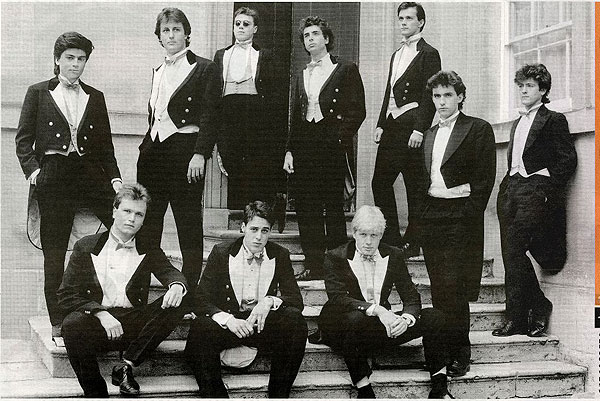
This shower of bastards sneaked in, and already they're wrecking the place like it was an unfortunate Oxford restaurant. The simplest way I can understand the situation is that these gentlemen have come to the conclusion that the only way to improve the economic climate in the UK (meaning stimulate opportunities for 'wealth creation', i.e. profit extraction for their friends) is to roll back the rights that our parents and their parents and their parents fought so very hard for so very long for. These hooligans have looked jealously at levels of exploitation in the third world and have thought "Bingo! That's what we need!" It beggars belief.

Not only have they managed to sell the country the mind-bogglingly stupid analogy of the economy being a cupboard that has been left empty by the profligate previous government, thus we're all (i.e. just the poor) going to have to starve, but they're also in the process of destroying the state higher-education system, squeezing the poor out of the inner cities, and crippling the NHS yet further.

As an intellectual, an aesthete, and a person with a strong attachment to the notion of the universality of humanity and its suffering (phew!), I've never felt more adrift from the zeitgeist. I want them stopped. They are bastards, and they're trying to ruin it for everyone apart from them and their clique. STOP THEM!

But then, inamongst this genuine anger, and despite the fact that as K-Punk so perfectly put it: 'history is starting again', there is always the looming fact that this is a systematic crisis in capitalist society, one that is of course intrinsically linked to the looming (unfolding?) environmental catastrophe. Perhaps capitalism might not collapse in the next 100 years, but it's going to get a lot more ugly, as if the world weren't already ugly enough. My wild prediction for what to expect from the next decade? Pogroms. Lots of 'em. All over the place, happening to all sorts of people. Maybe not, but something spectacular needs to be pulled out of the hat if we're going to avoid WWII levels of horror in the next generation or so (but of course, we saw WWII levels of horror in the last ten years in the Congo, didn't we? It just goes on and on…)
Trümmer auf Trümmer…

MUSIC OF THE YEAR!
Oh, it's difficult for me to talk about music much these days. I mean, it's still very very important to me, ridiculously so, but it feels strange to be a music lover nowadays. I hardly ever buy music any more, the occasional album by a contemporary artist, mostly experimental electronic-y stuff, but there's just such a hell of a lot of youtube watching, spotify listening and so on that I can discuss at length various aspects of 'the latest shit', without actually feeling any kind of enthusiasm for it. I suspect this is a very common feeling as the crisis of music consumption brought about by the internet becomes yet deeper, as the sense of discovery that once went hand in hand with finding new music vanishes yet further. I did go to see Hype Williams playing in Hoxton, for example, although I decided that I couldn't be arsed with the Salem gig at Shoreditch church.

I continued trying to practice, although business meant that certain projects I had going during the idleness of 2009 are now on the back-burner, perhaps indefinitely. This year I'd like to make recordings of some of the myriad arrangements that I have almost completed, if only to get them out of the way, to give oneself the feeling of having done something, anything!

2010 also saw me give proper time and consideration to Wagner, which led to some (what I thought were) fascinating insights into the High Romantic imagination and its relationship to technology. Verso reissued Adorno's book on Wagner, which is excellent, although I don't know if I can really be arsed reading what Badiou has to say about him in his newly published collection.

FILM OF THE YEAR!

Well, it's going to have to be Keiller's 'Robinson in Ruins', which I reviewed for ICON. One of the most striking things about this film was the way that the exquisite melancholy of his earlier Robinson films had given way to a sense of pessimistic dread, as Vanessa Redgrave read quotes of climate scientists earnestly discussing the imminent 'End of Life on Earth'.

Overall it certainly wasn't as good as the previous films - one got the sense that Keiller had turned his RCA research fellowship into a Robinson film only under duress, but I still cannot get over the breadth, intelligence and wit of his work, and I'm totally in thrall to its ability to draw out the embedded history and struggles that are latent in the landscapes we inhabit, while also making comprehensive artistic statements.

BOOK OF THE YEAR!
Accusations of clique-ness are probably well founded here, but Owen's book 'A Guide to the New Ruins of Great Britain' is a really stunning piece of work, a real demonstration that rather than the current standard of reactionary complacency posing as radical theorising all sheathed in unbearably turgid prose, it is eminently possible to combine architecture and politics in a work of genuine literary quality. Good for him!

Other literature that really stuck with me this year included Jonathan Littel's 'The Kindly Ones', Alisdair Gray's 'Lanark', & reading Geoffrey Hill's poetry.

BOOK OF NEXT YEAR!

In other literature news; I'm expecting that the first half of this year will see the publication of THE ARCHITECTURE OF FAILURE, the short book that I wrote about architecture, technology and weakness last year. Part history, part polemic, it takes a new look at the founding structures of modern architecture, the giant Iron & Glass palaces of the late 19th century. Instead of the triumphant expressions of technical prowess that they are generally understood to be, these buildings were expressions of a far more doubtful culture, which saw fragility, ghostliness and melancholy in their lofty transepts. This historical analysis begins to form a theory of architectural failure, a theory that starts to coalesce in the second half of the book where I apply it to three significant periods of architectural modernism, all of which have established conceptual links to these founding monuments - the 'Zoom' wave of Archigram et al, the Decon lot of the 1980s-90s, and the new generation of digiwibblists.

It will be neither conclusive neither definitive, but I would like to think that you'll enjoy it. I'll keep you posted.

Friday, 10 December 2010

Alfie Meadows

Alfie Meadows, lovely Middlesex philosophy student, was seriously injured by the police at yesterday’s protest, suffering bleeding on the brain and undergoing an emergency three-hour operation. Details here and here.

There is a solidarity vigil for Alfie outside the hospital where he is recovering TODAY. Please make it if you can:

URGENT:SOLIDARITY VIGIL with Alfie Meadows at 3:30 in front of Charing X Hospital in Hammersmith & Fulham Palace Rd. Bring banners on Police Brutality. Map here.

Thursday, 9 December 2010

Good Luck!


I just want to wish anyone who is marching, protesting, occupying, causing havoc, causing mayhem, getting attacked by police, taking over the tube, storming parliament & overthrowing the government tomorrow GOOD LUCK.

Some of us are in this together, the rest... well, we'll see what happens.

Tuesday, 7 December 2010

UCL Occupation visit


This blog has been rather silent of late, in what is turning out to be one of the most 'interesting' periods I can certainly remember. It's so strange, as I know that if I were still a student I'd be getting fully stuck in, but I've been left sat at desks, watching the protests as they unfold on the news and on twitter, wishing that I could be counted amongst the bodies.

So on Friday after 'the day job' I finally went down to the UCL occupation, in the company of Owen and Will and Joel, to see what was going on. Through the quad, the first thing that you notice is the chalk on the walls: in this case it was the old 'the point is to change it', which to be honest rather set the tone for some romanticised-quasi '68 nonsense. Once inside the building we were shocked to see that there was a soiree underway mere metres from the occupation, filled with champagne quaffing funders, seemingly completely unaware of what was going on a couple of doors down.

Past a security guard hanging around nonchalantly in a yellow jacket, up a few stairs, and past a table of people in their early twenties, opening a bag full of beers. Then pass through a pair of doors, and any notion that this is a rag-tag bunch of bourgeois hipsters, acting out while still at Uni is dispelled. There's about 50-100 people sitting around in a circle in front of a large projection on the wall of the agenda for a meeting. There's another 50 or so people milling around the periphery. One chap is trying to push the agenda along, while a young woman to his side is constantly inking a flipchart with points being made. There are laptops everywhere - some are twittering away, others -you imagine- are liaising with one of the many, many other occupations going on at the moment. The crowd are mixed more or less equally between the sexes, although the room is almost homogenously white. When people speak up they are mostly English and middle class - this is not an equivalent social group to that seen at the protests out on the streets in the last few weeks, although it's probably fair to say that more or less everyone in the room had been out there at the protests too.

The meeting is orderly - when people agree they shake their hands in the air, which I was told is something that you could see at the climate camp last year. The air is dedicated, but not necessarily professional, which may well be deliberate. It's certainly democratic, the chairperson merely trying to let as many people be heard while also moving everything forwards. Frequently, at the end of a discussion, someone will stand up and identify themself as the person to speak to afterwards if the point needs further discussion. It's very well organised, with people performing roles such as PR liaison and so on. You could easily run a business in this fashion, for what it's worth.

The meeting is adjourned, and a lot of people move off, but there are still around 100 people around, some off at the sides, and some bringing chairs up to the table. I had arrived thinking that I would just be hanging around, getting a look and then listening to Owen speak, but I suddenly find myself sitting behind the table, having to think up an impromptu talk myself.

Owen discusses 'Student Architecture', the latest ugly property bubble to get underway. Many luxury housing projects shelved when the recession hit are now returning as student flats, in which parents of foreign students are fleeced for up to £1000 a month for rooms that are yet smaller than the yuppiedromes that the developers no longer have the confidence to build. Owen rightly points out that companies like UNITE are among the most rotten and horrible developers in the construction industry, inflicting cheap and shitty buildings onto our cities that only a moron wouldn't recognise as repeating all the worst mistakes of the 1960s housing. It's truly shocking, and yet it just keeps on going.

I quickly try to discuss the uses and abuses of 'radical theory' in architecture over the last 50 years. Inspired by my reading an article about the occupation where architecture students said that they were inspired by the radical theories of Bernard Tschumi and Colin Fournier, I ramble somewhat, but try to get across the idea that if you are a clever architecture student who wants to read political theory that deals with space, don't go looking for it in the writings of architects. I prattle on about how because of the hermetic culture of architectural academia, and because of architects self-appointed renaissance man arrogance, as well as the futile nature of architecture practice in general, architect's theory often ends up as an awkward cloak that envelops all kinds of indulgences in its arcane misused terminology. I try to put across the point that theory has become a method of furthering one's career by doing a few years of academia, with radical theory aestheticised to the point that it can no longer be used as actual critique, and rather just adds a frisson of danger and exclusivity to one's formalism. I also mumble something about reading Lefebvre or Benjamin, but then I would say that, wouldn't I? My talk drifts off into silence, lacking any conclusion.

Will comes up next and discusses the privatisation of public space, and how one can read the subtle hints of it. He utters a great sequence about how classical architecture was intended to instil deference in its relationship with its public, and how modernism - especially post-Corbusian modernism - attempted to break down architecture to a more egalitarian form-human relationship, but then ended up being attacked for the supposed 'inhumanity' of those very forms. Now we have exclusivity expressed mainly through commercial space, seeing as genuinely non-shopping related public spaces are fewer and further between. And of course, this is accompanied by an insidious and worrying privatisation of all public space.

What was most heartening however; was that after the talks a discussion ensues for what I was told later was almost two hours. There are about forty of us, and we have a very interesting exchange of ideas. A few students want to discuss the occupation as a model for 'new space'. I think, yes, of course, it can be seen as an experiment in communal living, and lots can be learned, but at the same time there has been no real shortage of short term small scale experiments of this sort over the last 100 years. One student puts it well when she points out that they cannot say that what they are doing 'works', when they know that they are only likely to be there for a week more at most before being thrown out. I agree with her, in that occupation can only exist as an antagonistic bubble within a hostile wider environment. Owen points out that there were larger experiments with communal living in the early Soviet era - the Narkomfin for instance, and that they have a lot in common with post-war housing, as stepping stones to collectivity.

Another line of criticism is that the speakers have been too negative, offering only critique, and that there is a fertile world of community architectures and so on that need to be addressed and understood. Jeremy Till is mentioned. There is broad agreement from the panel, but also concern that again, the economics of scale have to be considered - I for one am very dubious that isolated examples can spread to become common practice without being adopted by some agency that has huge amounts of capital at its disposal - i.e. the State. Owen discusses Ralph Erskine's Byker Wall housing estate in positive terms.

There are also discussions of the state of architectural education, including the suggestion that the 1 student 1 project final year tradition is well overdue being abandoned as an inappropriate and unrealistic method. There is also a fair amount of 'what is to be done'?

Afterwards there is a performance by Slade students who are in occupation next door. At this point it becomes a bit too hipster-private-view for my liking, but then the occupiers have been working very very hard and deserve some relief, and some of the sketches performed are very funny. We are kindly supplied with a glass of wine, and a number of further conversations continue afterwards.

So… what? I was incredibly heartened by the occupation, but I am also fearful. The State is, of course, powerful, and obviously doesn't plan to stand for this kind of thing. But on the other hand, our dear leaders are fucking lightweights, with a background in PR and no real history of struggle. They hardly have a mandate, and even before any of their plans have begun they are facing massive protests, and the looming prospect of a g****** s*****. Thursday the 9th is coming up, and to be honest the government is going to win their vote. But it'll be an ugly win, one which only goes to show how utterly weak they actually are. The big question is how the heat of these occupations and protests will be kept up between now and March when the unions finally decide to get fully involved.

All in all the occupiers are very serious, resourceful and committed, and I wish them all the best, along with all the myriad other occupations, instant protests and actions.

And I should add that Aaron Porter is an absolute disgrace. It is in times like these that you see who is genuinely capable of empathy and strategy, and who is only concerned with their own well-trodden miserable career path. Scumbag.

My Christmas wish is that the students, the workers and the youth find their common ground and bring this zombie government down. Please Santa?

Saturday, 20 November 2010

Pre-Freudian Psychology.

One thing I can't quite understand about the ruling class is their attitude to culture. Seeing that they are generally very well educated, and seeing the reputation that high art and culture has, you would imagine that they would supportive of the arts. But no, like everything else that elevates us above germs, they find it superfluous to the demands of extracting profit.

So we have a long slow war of attrition waged against the BBC, among the most symbolic organisations in the world, which produces programmes such as 'Discovering Music', quite simply one of the most lovely things this island produces. This is a programme which is accessible but not patronising, which explores great art-music in detail, tying together the old problem of emotional and social impact with technical construction and execution, and is endlessly fascinating to boot. That our ruling class would want to destroy this in favour of private broadcasters who would never, ever commission something quite so informative and enriching, highlights the inherent contradictions of conservatism better than almost anything. Fuck them.


Here's some quotes from the programme, which are, let's face it, total E&V fodder...

The most famous chord progression in the history of music

Keeps fulfilment at bay

World of unfulfilled longing and endless desire

As we suddenly become aware of sexual attraction and painful desire

The most poignant interrupted cadence of all

We feel the music has come alive after the disjointed and lonely opening but it has only come alive to experience further heartache and unfulfilment.

But the harmony, like our unconscious lives, is never truly at rest. The structural goals in Tristan are moments of unfulfilment, disorientation and frustration of varying intensities.

We might think that at last the music is about to achieve emotional fulfulment. Longing and denial, both musically and psychologically, will be a thing of the past.

One of the mightiest climaxes in all music, a revelation of pre-Freudian psychology in which climactic achievement is merely an illusion.

In spite of the spiritual and erotic adventures, the striving and longing, we're back where we started.

From agony and unfulfilled desire in life, to mystical union in death.

This is orchestral genius at work.

This music still speaks to us today with a power that is hard to resist.

Wagner now begins to build his final overwhelming climax, striving for mystic union in death.

Only a compositional giant could have sustained such a span, and kept alive without monotony this world of agony and unfulfilled desire.
This was a work that revolutionised the composition of music.


I mean, there is an interesting argument to be had regarding the final chords of Tristan. It's quite easy (and actually quite correct) to identify the B major at the very climax as a kind of false unity, as posited by fascism. I mean, every time I listen to it, it sends shivers up and down my spine, I become liquid of limb and prone to swooning, but I know at the same time that it is a bare-faced metaphysical lie. This is why Mahler will always be an improvement on Wagner - listen to the disintegration at the end of the Adagio from Mahler 9, and you hear the unfulfilling disintegration of self-hood that is almost a perfect companion to the voice in Beckett's 'Malone Dies' - ever obsessed with an end that cannot be experienced from within the self that is utterly focussed upon it. Although Wagner is correct about desire, he is wrong about the Will.

Thursday, 18 November 2010

My V*ntage P*rn Soundtrack


Waltz in eb major (vintage pornography) by entschwindet und vergeht

Well! Thanks to Soundcloud and their lack of time limit (at least on individual tracks), you now have the dubious honour of being able to listen to all sixteen minutes of the vintage pornography soundtrack that Kino Fist commissioned from me, more than 3 years ago now (mein Gott!). It was entirely composed and teased out of a single recording I made of the sound of rain, using my own secret compositional recipe.